


The Missing Planet Problem
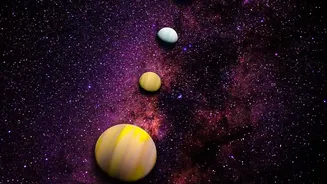
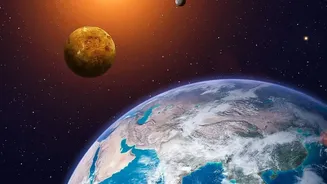
When astronomers look at other star systems, they frequently find “super-Earths”—rocky planets larger than our own but smaller than Neptune—orbiting close to their host stars. Yet, in our own celestial neighbourhood, the space inside Mercury’s orbit is
conspicuously empty. This has led scientists to wonder: why is our solar system so different? Are we an anomaly, or is there a more dramatic story hidden in our past? The answer, according to a growing body of evidence, may involve a ghost planet that was destroyed billions of years ago.
Meet the First Generation of Planets
The leading hypothesis suggests that long before Mercury, Venus, Earth, and Mars existed as we know them, a first generation of planets formed in the inner solar system. These weren't the relatively small terrestrial worlds we have today, but likely a collection of larger super-Earths. Researchers like Konstantin Batygin at Caltech have used simulations to show that the conditions in the early solar system were ripe for the formation of these larger worlds. So, if they existed, where did they go? The primary suspect behind their disappearance is the largest planet in our solar system: Jupiter.
Jupiter the Wrecking Ball
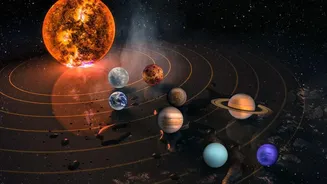
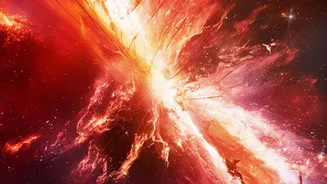
In a scenario known as the “Grand Tack,” scientists propose that Jupiter didn't always orbit where it does today. Early in the solar system's history, the gas giant is thought to have migrated inward, travelling as close to the Sun as the orbit of Mars. As it moved, its immense gravity would have acted like a cosmic wrecking ball, completely disrupting the orbits of any planets in the inner solar system. This gravitational chaos would have triggered a chain reaction of collisions, shattering the early super-Earths into a cascade of planetesimals—small planetary building blocks. Over a period of thousands of years, the vast majority of this debris would have been shepherded by Jupiter into the Sun, effectively clearing out the inner solar system.
The Evidence for Destruction
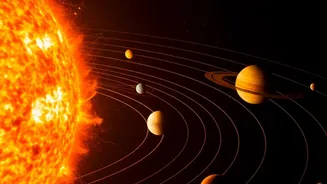
While this sounds like science fiction, the theory elegantly explains several key features of our solar system. Firstly, it accounts for the lack of close-in super-Earths. Secondly, it explains the relatively small masses of our current terrestrial planets, including Earth. According to simulations, the terrestrial planets we see today would have formed later from the leftover 10% of the material that wasn't swept into the sun during Jupiter’s rampage. A 2026 study also suggests that if a super-Earth did spiral into the sun, it might have left a chemical fingerprint, explaining why the sun has much less lithium than expected. The theory also provides a reason for the specific composition and distribution of the asteroid belt, which was likely scattered and repopulated by Jupiter's journey.
A Finely Tuned System
The idea of a lost planet highlights just how violent and chaotic the birth of a planetary system can be. It also raises a fascinating possibility: the destruction of this first generation of planets may have been a necessary step for life to eventually emerge on Earth. Research by astrophysicist Stephen Kane from UC Riverside has shown that adding a super-Earth into our current solar system, particularly between Mars and Jupiter, would likely destabilize the orbits of the inner planets, potentially ejecting Earth entirely. The absence of this planet, therefore, may be a key reason for our solar system’s long-term stability.