





A Summit of Ice, Not Rock
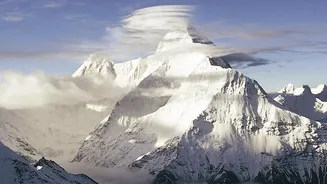
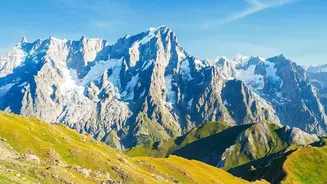
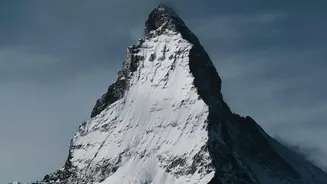
The fundamental reason for Mont Blanc's fluctuating height is that its summit isn't a solid, rocky peak. The very top of the mountain is a thick, permanent dome of ice and snow. While the rock summit underneath is stable at around 4,792 metres, the ice cap
on top can be anywhere from 15 to 20 metres thick. This icy layer is what grows and shrinks, leading to the different measurements recorded by surveyors every couple of years. In fact, the highest point of snow is often located dozens of metres away from the highest point of rock.
The Decisive Role of Weather
The thickness of the summit's ice cap is in a constant battle with the elements. The two main factors are precipitation and wind. Heavy winter snowfall adds mass and height to the ice cap. Conversely, high-altitude winds can scour snow from the summit, effectively lowering its peak. Therefore, the height measured in any given year is largely a snapshot of the weather patterns over the previous seasons. A year with heavy snow and low winds will likely result in a 'taller' Mont Blanc, while a dry, windy year could see its height decrease. For example, the 2023 survey recorded a drop of over two metres, while the 2026 measurement saw an increase of nearly two metres.
How Do They Even Measure It?
Since 2001, a team of expert surveyors has been conducting a measurement campaign every two to three years. This isn't a simple task. A team of around twenty people, including surveyors and mountain guides, ascends the peak carrying sophisticated equipment. They use high-precision GPS technology, placing receivers on the summit that record satellite signals to determine the altitude down to the centimetre. In recent years, drones have also been used to create detailed 3D models of the ice cap, providing a more comprehensive understanding of its volume and shape.
What About Climate Change?
It's tempting to directly link every height change to global warming, but researchers urge caution. While the broader Alpine region is clearly suffering from climate change, with glaciers retreating at alarming rates, the situation at Mont Blanc's summit is more complex. Because the summit is so high and cold, with temperatures around -20°C, it experiences polar-like conditions where significant melting is rare. Scientists stress that the short-term fluctuations are more indicative of annual weather variability than a direct, linear trend of climate change impact. The data is being collected over decades to build a long-term model. This will help future generations understand the true impact of climate shifts on this high-altitude environment.