


Our galaxy is filled with mysteries, but astronomers may have just solved a curious one. An unusual, high-energy glow with no obvious source has puzzled scientists, but a new theory suggests a dramatic origin: the ghost of a violent cosmic collision.
A Tale of Two Dead Stars
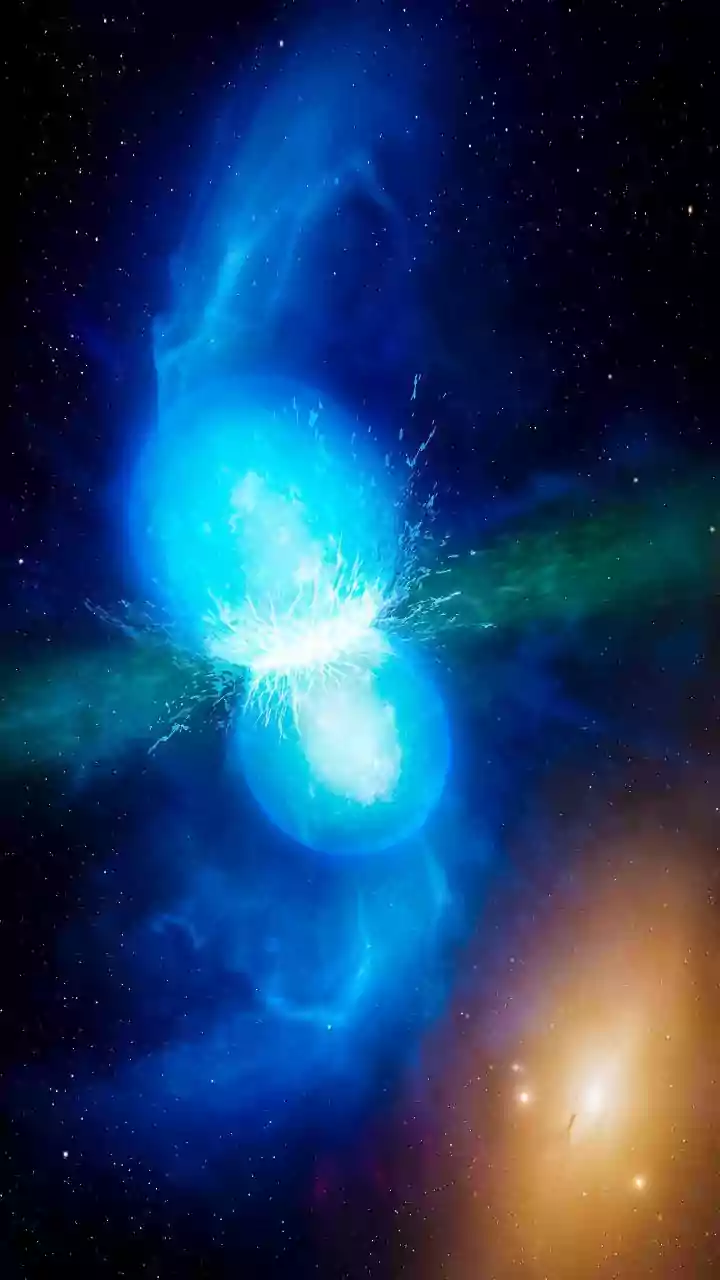
Before we get to the glow, let's talk about the suspects: neutron stars. These are the incredibly dense corpses of massive stars that have exploded in a supernova. Imagine the entire mass of our sun crushed into a sphere the size of a city. Now, picture two of these cosmic relics locked in a gravitational dance, orbiting each other for millions of years. As they circle closer and closer, they unleash powerful gravitational waves, ripples in the fabric of spacetime itself. The final moments are cataclysmic. They smash into each other at a fraction of the speed of light, triggering a 'kilonova' explosion—an event so powerful it forges many of the universe's heaviest elements, like gold and platinum.
The Mysterious Gamma-Ray Glow
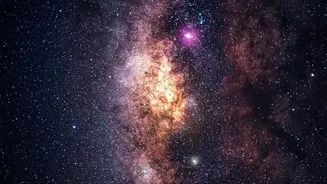
For years, astronomers have monitored a peculiar source of gamma rays—the most energetic form of light—in our Milky Way. Cataloged as HESS J1507−622, this glow was detected by telescopes in Namibia and stood out for two reasons. First, it had no counterpart in other wavelengths like X-rays or radio waves, which is unusual. Second, it was located far away from the galactic plane, the bustling, star-filled disk of the Milky Way where most high-energy sources are found. This suggested its origin was something out of the ordinary, perhaps an object that was violently 'kicked' out of its original home. Theories ranged from a specific type of supernova remnant to the annihilation of dark matter, but none fit the data perfectly.
Connecting the Cosmic Dots
A new study, posted on the preprint server arXiv, proposes a compelling explanation that ties everything together. Researchers from China and the United States suggest that the HESS J1507−622 glow is the afterglow of a neutron-star merger that happened less than 1,000 years ago. According to their models, the collision would have created a 'kilonova,' blasting out a shell of neutron-rich material. This rapidly expanding debris cloud, superheated by the explosion, is now interacting with interstellar gas, generating a shockwave that produces the gamma rays we see today. This 'kilonova afterglow' scenario neatly explains the glow's energy and its isolated location, as neutron star pairs can be ejected from their birthplaces before they merge.
A 'Young Bright Remnant' Left Behind
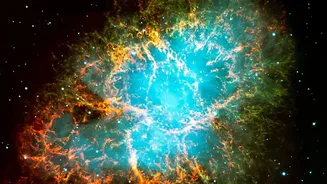
The phrase 'young bright remnant' points to the state of this afterglow. Because the blast is thought to have happened relatively recently in cosmic terms, the cloud of debris is still incredibly hot and energetic. This is why it shines so brightly in gamma rays. Had the event occurred much longer ago, the remnant would have cooled and expanded, making it far fainter and harder to detect. The theory posits that the initial flash of the merger, which may have been as bright as Jupiter in the night sky, was very brief and likely occurred in a part of the sky not easily observed by ancient astronomers in the Northern Hemisphere. This explains why there are no historical records of a 'guest star', unlike the famous Crab Nebula supernova of 1054.
Why This Cosmic Detective Story Matters
If this hypothesis is confirmed, it would be a landmark discovery. It would mark the first time a kilonova remnant has been identified within our own Milky Way galaxy. These events are considered the primary 'factories' for heavy elements in the universe. The gold in your jewellery, the platinum in industrial tools—scientists believe these atoms were forged in the heart of ancient neutron star collisions. Finding the leftovers of such an event in our galactic backyard would give scientists an unprecedented opportunity to study the process up close. It would allow them to test their theories about element creation and the physics of the most extreme events in the cosmos.