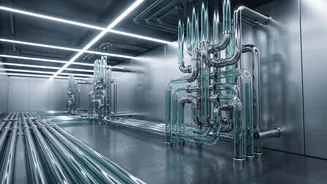








A New Breed of Digital Factory
Not all data centres are created equal. While traditional centres that store your emails and photos are powerful, the facilities required for artificial intelligence are a different beast entirely. Training and running large AI models require immense
computational power, primarily handled by thousands of graphics processing units (GPUs) clustered together. These AI-focused server racks can consume 3 to 5 times more power than their conventional counterparts, with some estimates putting a single AI rack's power draw at over 50 kilowatts, compared to 10-15 kilowatts for traditional computing. This has necessitated a shift to high-density designs that pack more power and advanced cooling into every square foot.
An Unprecedented Construction Boom
The numbers behind the AI data centre buildout are staggering. Recent projections estimate that global investment in AI infrastructure could reach $31.6 trillion by 2050, with some optimistic forecasts pushing that figure toward $50 trillion. To put that in perspective, this dwarfs the capital expenditure required for historical infrastructure revolutions like railways or the internet. In the U.S. alone, monthly spending on data centre construction has increased fivefold since late 2022. Unlike those past projects, this isn't a one-time build. The rapid evolution of technology means GPUs and other critical hardware may need to be replaced every four to six years, creating a recurring cycle of massive investment.
The Search for Power
The single biggest constraint on this AI-fueled expansion is energy. AI's thirst for electricity is immense and growing exponentially. Today, data centres consume around 1.5% of the world's electricity. However, AI servers are expected to consume more power than all conventional data centre hardware combined by 2027. Some new, large AI facilities are projected to use as much electricity as hundreds of thousands of homes. This massive demand is putting a severe strain on local and national power grids, with utilities struggling to keep pace. As a result, access to affordable, reliable, and increasingly low-carbon power has become the single most decisive factor in determining where these multi-billion dollar facilities get built.
The Environmental Toll
Beyond electricity, the environmental footprint of data centres is a growing concern. Cooling the thousands of heat-generating servers requires vast quantities of water. A large data centre can use millions of gallons per day, equivalent to a small city, placing a burden on local water supplies, particularly in water-stressed regions. The land required for these sprawling campuses also has an impact, sometimes replacing forests or other natural landscapes. While the industry is pursuing innovations like liquid cooling and investing in renewable energy, the sheer scale of the buildout presents a significant environmental challenge, with the carbon, water, and land footprints all demanding careful management.
The Global Race Heats Up
The race to build AI infrastructure is a global one. The United States is projected to capture the largest share of investment, nearly half of the global total through 2050. However, the Asia-Pacific region, led by China and India, is also a major hub of activity. Furthermore, a push for "sovereign AI" is driving nations in Europe and the Middle East to invest heavily in their own domestic data centre capabilities to ensure data residency and regulatory compliance. This global competition for digital supremacy is reshaping investment flows, with access to power and advanced chips being key battlegrounds.