







A Journey Beyond the Sun
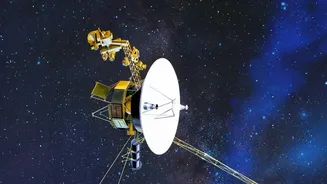
Launched in 1977, the twin Voyager 1 and Voyager 2 spacecraft have become humanity's most distant explorers. After a historic “grand tour” of the outer planets—Jupiter, Saturn, Uranus, and Neptune—they pushed onward, becoming the only probes to ever enter
interstellar space, the region beyond our sun's influence. They are, in essence, time capsules from another era, equipped with less memory than a modern smartphone, yet they remain at the absolute frontier of exploration. Their mission today is to sample the interstellar medium directly, providing data on cosmic rays, magnetic fields, and plasma that no other instrument can capture. This information is changing our understanding of the boundary that separates our solar system from the rest of the galaxy.
The Inevitable Power Decline
The secret to the Voyagers’ incredible longevity is their power source: radioisotope thermoelectric generators (RTGs). These are not solar panels, which would be useless so far from the sun, but nuclear batteries that convert heat from decaying plutonium into electricity. However, this power source has a finite lifespan. Every year, the natural decay of the plutonium means the probes lose about four watts of available power. After nearly half a century in the frigid dark of space, the power margins have become razor thin. Mission engineers at NASA's Jet Propulsion Laboratory (JPL) are now in a constant battle against this slow, inevitable decline, managing every last watt of energy.
A Calculated Sacrifice
To keep the science flowing, the Voyager team has to make sacrifices. This involves shutting down systems to conserve energy. Some of these were easy decisions, like turning off the cameras and other instruments designed for planetary flybys decades ago. More recently, the choices have become harder. In April 2026, the team was forced to switch off the Low-Energy Charged Particles (LECP) instrument on Voyager 1 after an unexpected power dip. This wasn't a choice anyone wanted to make, as the LECP was providing crucial data about the interstellar medium. The alternative, however, was risking an automatic shutdown of the entire spacecraft. These decisions follow a long-established plan, prioritizing the instruments that can still provide unique science from their vantage point in the cosmos.
The 'Big Bang' Solution
In a recent and more daring move, engineers on the Voyager 2 team executed a maneuver nicknamed the “Big Bang.” Instead of shutting down another precious science instrument, they performed a coordinated swap: simultaneously turning off certain non-essential powered devices and replacing them with lower-power alternatives, all while ensuring the spacecraft’s critical fuel lines remained warm enough to function. The delicate operation, conducted on a spacecraft so far away that a command takes nearly a day to arrive, was a calculated risk. It successfully freed up enough power to keep Voyager 2's three remaining science instruments running for at least another year. A similar power-saving effort is now being planned for Voyager 1.
The Science That Endures
Even with a reduced instrument suite, the science the Voyagers continue to deliver is priceless. Voyager 1 still operates its magnetometer and a plasma wave instrument, listening to the hum of plasma waves and measuring the magnetic fields of interstellar space. Voyager 2 has three instruments still active. This data provides our only direct measurements of the environment outside the protective bubble of our sun, known as the heliosphere. Every signal sent back, traveling for nearly a day to reach Earth, is a postcard from a place humanity has never been before and may not reach again for a very long time.