







Two New Powerhouses in Chennai
On September 7, 2026, Agnikul Cosmos officially opened two new units at its assembly and testing facility in Chennai. The additions were inaugurated in the presence of Group Captain Shubhanshu Shukla, one of the astronaut-designates for India's Gaganyaan
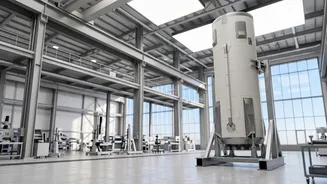
mission. The new facilities are named the Stage Testing & Inspection Facility (STIF) and the Pressurant Tank Realisation, Over-wrapping and Outfitting Facility (PROOF). This expansion significantly enhances Agnikul's in-house capabilities, positioning it as a serious contender in the global race to make space launches more affordable and sustainable. Specifically, this infrastructure is designed to tackle the immense challenge of developing, testing, and reusing rocket stages.
The Reusability Revolution
For decades, rockets were single-use machines. Like a disposable paper cup, every part of the launch vehicle was discarded after one flight, making space access incredibly expensive. Companies like SpaceX changed the game by proving that first-stage rocket boosters could be landed, refurbished, and flown again, drastically cutting costs. This is the goal Agnikul is chasing. By developing reusable rockets, the company aims to make launching small satellites, a booming market, much more economical. Their flagship rocket, Agnibaan, is being designed with this principle at its core. The new Chennai facilities are the physical foundation for turning this ambitious vision into a repeatable, reliable process.
What 'Requalify' Actually Means
The headline's use of "requalify" is key. Building a reusable rocket is only half the battle; the other half is proving a recovered stage is safe to fly again. This is where STIF comes in. This facility is designed to test complete rocket stages under flight-like conditions, integrating both the propulsion and avionics systems. It can conduct full-duration engine burns and simulate the intense stresses of a launch. After a mission, a recovered rocket stage would be brought to STIF for rigorous inspection and testing. This post-flight requalification process is a critical, complex, and non-negotiable step to ensure the vehicle's integrity for its next launch. Agnikul is now the only private Indian company with in-house infrastructure for this crucial process.
Bringing Manufacturing In-House
The second facility, PROOF, is about gaining control over the supply chain. It allows Agnikul to manufacture its own high-pressure composite overwrapped pressure vessels (COPVs), which are essential components for holding gases at immense pressure within the rocket. Instead of relying on external suppliers, Agnikul can now produce these critical parts in-house, with a capacity of over 10 vessels per month. This vertical integration reduces dependency on outside vendors, gives the company greater control over quality, and speeds up production timelines and design improvements. It's another step towards creating a seamless cycle of building, testing, flying, recovering, and requalifying their launch vehicles.
The Road Ahead for Agnibaan
This infrastructure is not just for theoretical development; it's a direct enabler for Agnikul's upcoming flights. Following the successful suborbital test flight of Agnibaan SOrTeD in May 2024, the company is preparing for Mission-02. This next mission is slated to be India's first private attempt at recovering an orbital-class rocket booster. The ability to test and validate the entire stage at STIF is crucial for the success of Mission-02 and all subsequent flights. As stated by Agnikul's co-founder and CEO, Srinath Ravichandran, these facilities provide the capability to think beyond a single flight and build a truly reusable system from the ground up.