




A Spectrum in the Sky
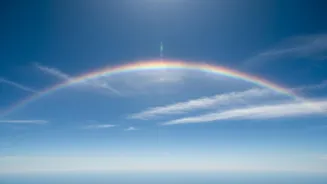
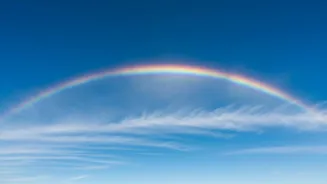
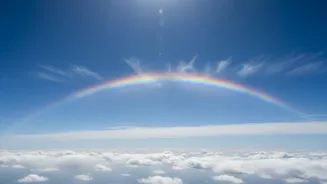
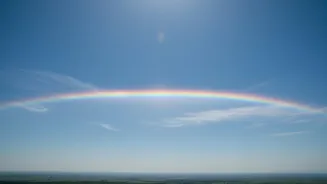
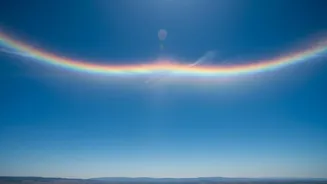
Recent images shared and explained by NASA highlight a spectacular optical event often nicknamed a “fire rainbow.” These displays appear as a vibrant, multi-coloured band running parallel to the horizon. Unlike a typical arched rainbow, this phenomenon
looks like a section of the sky itself has been painted with pastel hues, with red as the topmost colour. NASA's Astronomy Picture of the Day (APOD) service often features such images, explaining that the flame-like appearance is what gives it its common name, though it has nothing to do with fire. When seen in patchy, wispy clouds, the fragments of colour can look like ethereal flames dancing in the sky.
Not Fire, Not a Rainbow
Despite its popular nickname, the phenomenon is neither fire nor a true rainbow. Its scientific name is a circumhorizontal arc. While rainbows are formed by the refraction and reflection of light within liquid water droplets, a circumhorizontal arc is created by ice. It belongs to a family of atmospheric optical events called ice halos. The name might be a mouthful, but it’s descriptive: 'circumhorizontal' refers to the way the arc stretches parallel to the horizon. The term “fire rainbow” is believed to have been coined around 2006 and has stuck due to its evocative nature, but scientists prefer the more accurate term.
The Three Essential Ingredients
For a circumhorizontal arc to form, a precise set of three conditions must be met. First, you need high-altitude cirrus clouds. These are the thin, wispy clouds found at altitudes where the temperature is low enough for them to be composed of millions of tiny ice crystals instead of water droplets. Second, these ice crystals must be hexagonal (six-sided) and shaped like flat plates. Crucially, they have to be oriented horizontally, with their flat faces parallel to the ground, so they act in unison. The final, and most critical, ingredient is the sun's angle. The sun must be very high in the sky, specifically at an elevation of more than 58 degrees above the horizon.
A Trick of Light and Ice
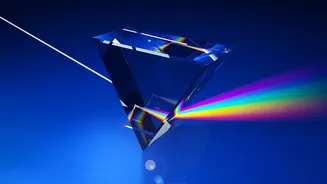
The magic happens through a process called refraction. When sunlight enters the vertical side face of one of these plate-shaped ice crystals, it bends. It then bends again as it exits through the bottom horizontal face. This 90-degree path that the light takes acts like a prism, splitting the white sunlight into its component spectrum of colours. Because the millions of ice crystals in the cirrus cloud are all aligned horizontally, they all refract the light in the same way. The result is a massive, cohesive band of colour. The colours are well-separated and often appear purer and more vibrant than those in a typical rainbow. The phenomenon is most intense when the sun is at an elevation of about 68 degrees.
A Rare and Fleeting Sight
The strict requirements for forming a circumhorizontal arc make it a relatively rare sight. The sun's elevation of over 58 degrees means these arcs are more commonly seen in the summer and at mid-latitudes. In locations north of 55° N or south of 55° S, the sun never gets high enough in the sky for a circumhorizontal arc to be visible. For example, in a city like Los Angeles, the window for seeing one is about 670 hours between late March and late September. In London, that window shrinks to just 140 hours between mid-May and late July. Even when conditions are perfect, the presence of the right kind of cirrus clouds is not guaranteed, making any sighting a special event.