

A Cosmic Mystery
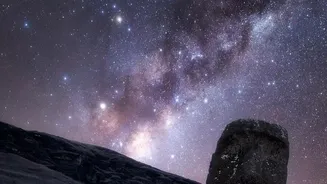
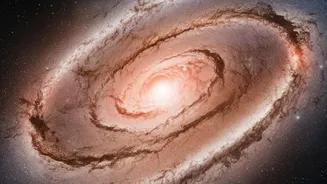
For years, astronomers have been puzzled by a curious feature of our galaxy. The main disk, where our Sun resides, spins at a brisk 220 kilometres per second. But surrounding this disk is a vast, sparse sphere of ancient stars called the stellar halo.
Data from the European Space Agency's Gaia mission revealed that this halo rotates far more slowly, at a mere 25 kilometres per second. This discrepancy pointed to a dramatic event in the Milky Way's history, but scientists weren't sure what it was.
The Prime Suspect: A Galactic 'Sausage'
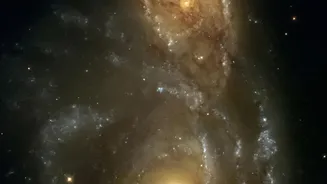
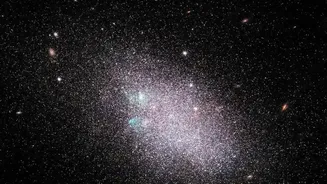
The culprit appears to be a massive dwarf galaxy that collided with a young Milky Way between 8 and 11 billion years ago. Astronomers have affectionately nicknamed this interloper the 'Gaia-Sausage-Enceladus' (or Gaia Sausage for short) because of the elongated, sausage-like orbits its stars were thrown into after the crash. This wasn't a glancing blow; it was a defining, head-on collision that fundamentally reshaped our galaxy. The Gaia Sausage was torn to shreds and absorbed, but not before delivering a shock that would alter the Milky Way's destiny.
Flipping a Galaxy
To understand the slow-moving halo, researchers at Durham University ran powerful supercomputer simulations of galactic evolution. They discovered that galaxies experiencing a major, head-on merger like the one with the Gaia Sausage were likely to undergo a 'disc flip'. This means the gravitational chaos from the collision could have exerted enough force to slowly tilt the entire disk of the Milky Way by more than 90 degrees, essentially flipping it onto its side over hundreds of millions of years. This gradual reorientation within the galaxy's larger, invisible dark matter halo would explain the slow rotation we see in the stellar halo today.
A Violent, Formative Past
The Gaia Sausage collision is now recognised as the last major merger in our galaxy's history. It didn't just reorient the disc; it also contributed to the formation of the dense bulge of stars at the galaxy's centre and populated the stellar halo with debris. Although classified as a dwarf galaxy, the Gaia Sausage was immense, containing stars, gas, and dark matter equivalent to more than 10 billion times the mass of our Sun. This event shows that galactic formation isn't a gentle process but a story of violent cosmic accidents and transformations. The evidence suggests that even our own Sun might have once travelled on a completely different path through the galaxy before this ancient upheaval.