


What Exactly is the Lucy Mission?
Launched on October 16, 2021, NASA’s Lucy mission is a 12-year-long expedition to explore a record-breaking number of asteroids. The primary targets are the Jupiter Trojan asteroids, two large swarms of space rocks that share Jupiter's orbit around the sun.
One swarm travels ahead of the gas giant, and the other trails behind it. Named after the 'Lucy' fossil, which provided insights into human evolution, this mission aims to study the 'fossils of planet formation'. The asteroids it will visit are believed to be pristine remnants from the birth of our solar system more than four billion years ago. By studying them up close, scientists hope to unlock vital clues about how the planets, including Earth, came to be.
An Uncharted Cosmic Territory
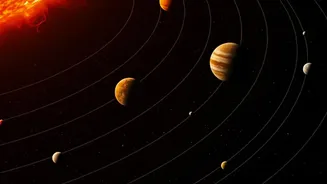
The Trojan asteroids are held in place by the gravitational balancing act between the Sun and Jupiter at special points in space known as Lagrange points. The leading swarm, which Lucy has now entered, is centered around the L4 Lagrange point. While space has no official borders, engineers confirmed Lucy's arrival by tracking its radio signals against the background of stars. This region is a vast and largely unexplored 'island of stability' where thousands of asteroids orbit. No spacecraft has ever visited them before. Lucy's arrival marks the beginning of the main scientific phase of its journey, moving from a long cruise to a series of targeted encounters.
A Few Surprises Along the Way
Lucy's journey hasn't been a simple straight line. It has already completed two gravity-assist flybys of Earth to gain speed and adjust its trajectory. On its way to the Trojans, it has also conducted some bonus science. In November 2023, Lucy flew by a main-belt asteroid named Dinkinesh and made a shocking discovery: it had a small satellite, now named Selam. More surprisingly, Selam was revealed to be a 'contact binary'—two objects fused together, a type of satellite never seen before. The mission also had a flyby of another main-belt asteroid, Donaldjohanson, in April 2025. These encounters served as crucial engineering tests for the spacecraft's systems ahead of the main event.
What's Next on Lucy's Itinerary?
Entering the Trojan region is a major step, but the asteroids are still incredibly far apart, separated by an average of 6 million miles. For now, they will just be pinpricks of light. The first closeup encounter in this region is scheduled for August 11, 2027, when Lucy will fly past the asteroid Eurybates and its moon, Queta. This will be followed by flybys of three more Trojans: Polymele in September 2027, Leucus in April 2028, and Orus in November 2028. During each of these brief, hourslong encounters, all of Lucy's instruments will work in a carefully planned sequence to gather as much data as possible on the asteroids' composition, density, and geology.
The Journey Continues
Even after visiting the first swarm, Lucy's tour is far from over. In 2030, the spacecraft will loop back toward Earth for a third and final gravity assist. This maneuver will slingshot it toward Jupiter's trailing swarm of Trojans, located at the L5 Lagrange point. There, in March 2033, Lucy will visit its final target: the fascinating binary pair of Patroclus and Menoetius. By visiting both swarms, scientists will be able to compare these two distinct populations of ancient relics for the first time, testing theories about how our solar system was built and evolved.