








A Promising Mission Goes Silent
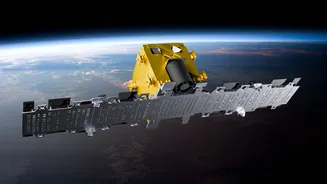
Bengaluru-based startup GalaxEye's maiden satellite, Mission Drishti, has lost communication following a geomagnetic solar storm. Launched on May 3, 2026, aboard a SpaceX Falcon 9, the satellite was celebrated as a milestone for India's private space
industry. It was the country's largest privately developed Earth observation satellite and the world's first to combine both optical and Synthetic Aperture Radar (SAR) sensors. This would have allowed it to see through clouds and darkness. After successfully completing most of its initial in-orbit tests, the spacecraft encountered an anomaly on July 7 during the storm. Initial analysis suggests radiation from the event damaged a critical system, and while recovery efforts are ongoing, the company states the chances are low.
What is a Solar Storm?
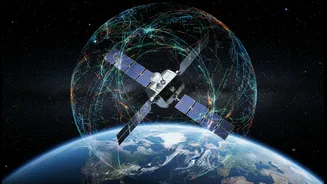
Think of a solar storm as a massive eruption from the Sun. These events, called Coronal Mass Ejections (CMEs), hurl vast clouds of charged particles and magnetic fields into space. If Earth is in the path of a CME, these particles interact with our planet's magnetic field and upper atmosphere. For satellites in orbit, this is a multi-pronged threat. The sudden influx of radiation can damage sensitive electronics, causing 'single-event upsets' that can flip bits in a computer's memory or cause complete system failure. The storm also heats and expands Earth's upper atmosphere, increasing the atmospheric drag on satellites in low-Earth orbit. This can cause them to lose altitude and, in severe cases, lead to premature re-entry, as famously happened to dozens of Starlink satellites in 2022.
More Than Just One Satellite
The loss of Mission Drishti is more than just a technical setback for one company. India's private space sector, which has seen the birth of over 200 startups since 2020, is at a crucial stage of proving its capabilities and reliability. A successful mission from a company like GalaxEye, which is backed by major investors, would have boosted confidence across the entire ecosystem. This event serves as a stark reminder of the inherent risks in the space business, impacting everything from investor sentiment to insurance premiums for future missions. The success of these private ventures is seen as critical for India to grow its share of the global space economy from the current 2-3%.
A Rite of Passage
While disappointing, facing challenges from space weather is not unique to Indian startups. Every space-faring nation and company, including giants like NASA and SpaceX, constantly contends with the Sun's activity. During major solar storms, it's common for satellites to be put into a protective 'safe mode' or require orbit corrections due to increased drag. This incident, therefore, can be seen as a difficult but necessary rite of passage for India's private industry. It's a real-world test against one of the fundamental challenges of operating in space. As one CEO in the sector noted, the challenges are real, but the momentum for Indian deep tech is also very real.
The Path Forward: Building Resilience
The experience with Mission Drishti, though painful, provides invaluable data. GalaxEye's CEO, Suyash Singh, stated that the mission provided engineering insights that will directly strengthen future spacecraft. For the broader industry, the event underscores the need for robust satellite 'hardening'—shielding electronics against radiation—and better space weather prediction models. It also highlights the importance of resilient designs and potentially bringing more manufacturing and quality control in-house, a step GalaxEye plans to take. This hurdle forces the burgeoning sector to mature, learning from a setback to build more resilient systems for the long journey ahead.