


The Arctic's Cloudy Mystery
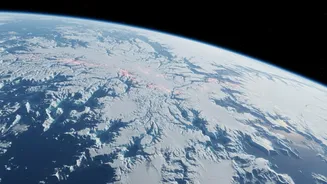
For decades, scientists have treated the Arctic as a critical barometer for global climate health. It acts as the planet's refrigerator, helping to cool the entire system. However, this region is warming at least three times faster than the global average.
One of the biggest uncertainties in predicting the future of our climate lies within the wisps of white that drift over the ice: clouds. Clouds have a dual personality; they can reflect sunlight back into space, creating a cooling effect, or they can trap heat like a blanket, causing warming. In the Arctic, their behaviour is especially complex and hard to predict, making them a massive puzzle piece for climate scientists.
A Burst of Cloud Seeds
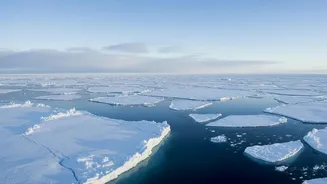
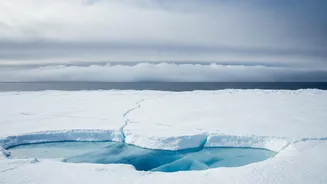
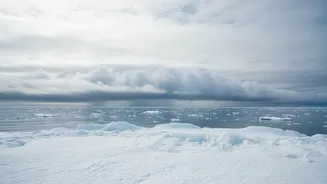
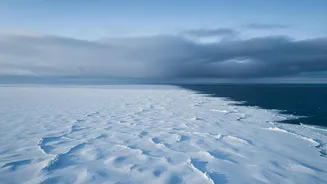
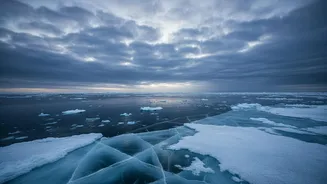
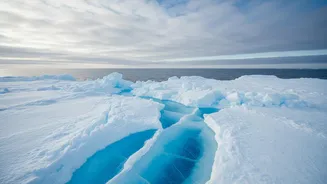
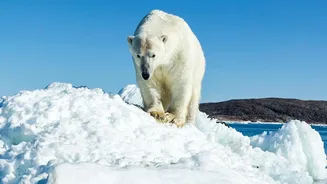
To form a cloud, water vapour needs a 'seed' to condense upon—a tiny airborne particle known as an aerosol. A groundbreaking new study published in Nature Geoscience has uncovered a powerful, previously hidden source of these particles. Researchers found that at the marginal ice zone—the dynamic border where sea ice meets the open ocean—a unique chemical process is taking place. As the ice melts, marine algae in the water are exposed to sunlight, releasing a potent cocktail of iodine, sulphur, and organic compounds. Triggered by sunlight, these chemicals react in the atmosphere to create a massive burst of new particles that can seed clouds.
A Fifty-Fold Increase
The scale of this phenomenon surprised researchers. During one observed event, the concentration of cloud-seeding particles in the air jumped by fifty times in a single day. This process of 'new particle formation' was observed on more than 80% of sunny days, showing it's a common occurrence. The discovery helps explain long-standing mysteries about how clouds form in the relatively pristine Arctic air, which lacks the high levels of pollution-based aerosols found in other parts of the world. This new finding adds a crucial variable that climate models have been missing.
Refining Our Climate Future
The implications are significant. Current climate models struggle to accurately represent Arctic clouds, which leads to uncertainty in projecting the pace of future warming. By missing this powerful natural particle source, our predictions may have been incomplete. Including this new mechanism will allow scientists to build more accurate models. The effect could be complex: more clouds in the summer might reflect sunlight and slow down the rate of ice melt. However, more clouds in other seasons could trap heat, potentially accelerating warming. Understanding this balance is now a key priority for climate modellers.
Why the Arctic Matters for India
What happens in the Arctic does not stay in the Arctic. The region's climate has a direct and increasingly understood link to India's weather patterns. Studies by Indian researchers have shown a strong connection between declining Arctic sea ice and changes in the Indian Summer Monsoon. Reduced sea ice has been linked to a westward shift and increased intensity of late-season monsoon rains in parts of India. As the Arctic continues to warm and this newly discovered cloud-seeding process potentially evolves, the predictability of the monsoon—which is vital for India's agriculture and economy—could be further impacted.