



1. Banded Plié Squat
The plié is a fundamental movement in ballet, and adding a resistance band turns it into a powerful tool for your glutes and thighs. Place a looped resistance band just above your knees. Stand with your feet slightly wider than shoulder-width apart, with your toes
turned out comfortably, mimicking the first position in ballet. Keeping your chest up and core engaged, lower yourself into a squat, pushing your knees outward against the band’s tension. Go as low as you can while maintaining a straight back, then press through your heels to return to the starting position, squeezing your glutes at the top. This exercise is excellent for strengthening the hip abductors and improving turnout, which is crucial for stability in dance.
2. Standing Glute Kickbacks
Glute kickbacks are fantastic for targeting the gluteus maximus, the muscle that powers jumps and extensions. To perform this with a dance-like feel, stand facing a wall or ballet barre for support. Loop a resistance band around your ankles. With a slight bend in your supporting leg, engage your core and extend the other leg straight behind you, keeping your foot pointed. Focus on squeezing the glute of the working leg as you lift. The movement should be controlled, like a graceful tendu to the back, rather than a forceful kick. This builds the strength needed for powerful arabesques and improves your balance. Avoid arching your back; the movement should originate from your hip.
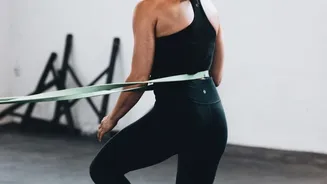
3. Lateral Band Walks
Dancers need strong hips for stability and control, and lateral walks are a perfect way to target these muscles. Place a resistance band around your ankles or just above your knees for an easier variation. Assume a slight squat position with your feet hip-width apart, keeping your core braced and chest up. Step sideways, maintaining tension on the band at all times. Don't let your feet come together. Take several controlled steps in one direction, then repeat on the other side. This exercise strengthens the gluteus medius, a key stabilizer for the pelvis. This stability is vital for everything from holding a balance to landing a leap safely.
4. Banded Clamshells
This exercise is a subtle but mighty move for targeting the deep external rotators of the hip and the gluteus medius. These muscles are often underactive but are essential for controlling turnout and preventing injuries. Lie on your side with your knees bent at a 90-degree angle and a resistance band looped just above them. Stack your hips and keep your feet together. Engage your core to keep your pelvis stable, then lift your top knee towards the ceiling without rocking your hips back. Hold for a moment at the top, feeling the engagement in your outer hip, then slowly lower your knee. This controlled movement improves hip stability, which is foundational for almost every dance step.
5. Banded Reverse Lunge with a Twist
This compound movement combines lower body strength with core work, mimicking the dynamic twists and turns of dance. Stand with your feet together and loop a resistance band under your front foot. Hold the other end of the band with both hands at chest level to create tension. Step your other leg back into a reverse lunge, lowering both knees to about 90-degree angles. As you lunge, twist your torso toward your front leg, pulling against the band. This rotation engages your obliques and challenges your stability. Return to the center as you push off your back foot to stand up. This exercise builds functional strength for dynamic movements and improves rotational control, which is key for pirouettes and quick changes of direction.