




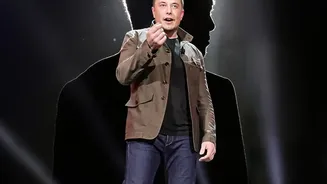
What Did Musk Actually Say?
In a recent post on his social media platform, X, Elon Musk weighed in on a surprisingly contentious grammatical issue. He argued that the rules of English should be updated to include spaces around em dashes. His reasoning was twofold: without spaces,
the em dash (—) too closely resembles a hyphenated word, and as a piece of punctuation, he finds it 'unpleasantly long'. He even suggested its shorter cousin, the en dash (–), is a better length for parenthetical thoughts. For a man preoccupied with sending rockets to Mars and rewiring the global town square, it was a curiously specific—and provocative—take on typography.
A Dash of Context
To understand the drama, you first have to know your dashes. The em dash is the longest of the three common dashes (hyphen, en dash, em dash). Its name comes from old printing terminology, where it was roughly the width of a capital letter 'M'. Its purpose is to set apart a phrase or clause, often with more emphasis than a comma or parentheses. It can signal an abrupt change in thought or an interruption. Think of it as a dramatic pause—a tool for rhythm and emphasis used by authors from Emily Dickinson to modern journalists. The current controversy, however, isn't about whether to use it, but how.
The Great Spacing Debate
Musk’s proposal for spaces around the em dash isn't new; it lands squarely in the middle of a long-standing stylistic war between the titans of typography. On one side is The Associated Press (AP) Stylebook, the guide used by most newspapers and journalistic outlets. AP style calls for a space before and after the em dash. The logic is rooted in the narrow columns of newspapers, where the extra white space improves readability. On the other side is The Chicago Manual of Style (CMOS), the bible for book publishing and most academic writing. Chicago style dictates no spaces around the em dash, creating a seamless, uninterrupted line of text. So when Musk called for a rule change, he was unknowingly (or knowingly) taking sides in a debate that has divided editors and writers for decades.
Why Writers Care So Much
To an outsider, the argument might seem trivial. It’s a space, after all. But for writers and editors, punctuation is a craft. The choice between a spaced or unspaced dash affects the visual rhythm of a sentence and signals adherence to a professional standard. For many book editors, seeing spaces around an em dash is an immediate sign of an unpolished manuscript. For journalists, the opposite is true. Beyond the rules, there's a growing cultural dimension. In recent years, an overuse of em dashes has become associated with AI-generated text, as large language models often lean on them to create an illusion of sophisticated sentence structure. This has made some human writers wary of the mark, fearing their work might appear machine-written. Musk, a key figure in the world of AI, stepping into this debate adds a layer of irony that was not lost on the literary community.
The Bigger Picture
Ultimately, the spat over the em dash is about more than just a sliver of punctuation. It’s a conversation about who sets the rules for language. Is it the traditional guardians of style—the editors and publishing houses? Or is it shaped by the platforms we use and the influential figures who own them? Musk's platform, X, has already fundamentally altered how millions communicate, prioritizing speed and brevity. His attempt to influence formal grammar, whether serious or casual, highlights the power that tech leaders wield over culture. While grammarians debate the merits of AP versus Chicago, the digital world continues to evolve its own linguistic norms, often with little regard for legacy rulebooks.