




A Galaxy in Gentle Decline
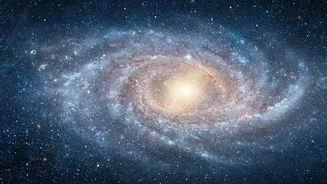
Our closest large galactic neighbor, the Andromeda galaxy, is running out of steam. According to a new, comprehensive census by the Hubble Space Telescope, the rate of star birth in Andromeda has been steadily falling for the last 500 million years. The
decline has become even more pronounced in the last 40 million years, a finding that gives scientists an unprecedented look at how large spiral galaxies like our own Milky Way begin to age. Researchers calculated that 500 million years ago, Andromeda was creating new stars at a rate of about one solar mass per year. Today, that rate has plummeted to about one-fifth of that, signaling a major shift in the galaxy's life cycle. It’s a slow, graceful fade rather than a sudden stop, providing a unique window into the future of galaxies.
Cosmic Fossil Hunting with Hubble
To uncover this slow decline, astronomers embarked on a massive project to create a stellar fossil record. They combined data from two of Hubble's largest surveys: the Panchromatic Hubble Andromeda Treasury (PHAT) and the Panchromatic Hubble Andromeda Southern Treasury (PHAST). Together, these surveys mapped roughly two-thirds of Andromeda's sprawling disk, cataloging an astonishing 200 million individual stars. This feat was only possible with Hubble's sharp vision, which can resolve individual stars even at a distance of 2.5 million light-years. By analyzing the color of the stars—younger, massive stars shine blue, while older, less massive stars glow redder—scientists could determine when and where star formation had occurred. They divided the galaxy into thousands of 300-light-year-wide squares and built a historical map of its productivity, one stellar generation at a time.
Why is Andromeda Slowing Down?
The slowdown doesn't seem to be for a lack of raw materials. Instead, it appears to be a natural winding down period after a more active youth. Previous research showed Andromeda experienced a massive burst of star formation about 2 billion years ago, likely triggered by a merger or close encounter with another, smaller galaxy. Since that intense period, activity has been gradually tapering off. Much of the recent star-making has been concentrated in a huge ring about 32,000 light-years from the galactic center, and it's the fading of this ring that is driving the overall decline. Tobin Wainer, the study's lead author, poetically described it as a galaxy that needs to "take a bit of a breather" after running a marathon.
A Tale of Two Galaxies
This discovery is particularly fascinating because it sets up a stark contrast with our own galaxy. While Andromeda is entering a quieter phase, the Milky Way is still a bustling stellar factory, producing stars at a rate of about 3-5 solar masses per year—significantly higher than Andromeda's current rate. This difference in activity adds a new layer of intrigue to the long-foreseen cosmic event: the collision of the Milky Way and Andromeda, expected to occur in about 4.5 billion years. When these two galaxies eventually merge, they will combine one galaxy that is actively building stars with one that has already begun its transition into a more quiescent state. This new understanding of Andromeda's evolution will help scientists better model what will happen when our two cosmic systems finally meet.