


The Challenge of Seeing the Unseen
Accurately mapping an asteroid is a fundamental task for space science and, more critically, for planetary defense. Most asteroids are too small and distant to be seen as more than a point of light from Earth. Scientists have to estimate their size based
on brightness, a method filled with uncertainty because a small, highly reflective asteroid can appear just as bright as a large, dark one. Getting a true sense of an asteroid's dimensions often requires a direct visit from a spacecraft, using advanced radar or imaging techniques. Even then, what a spacecraft finds can be completely unexpected. This is crucial because knowing an asteroid's precise size, shape, and composition is the first step in determining if it poses a threat and how one might deal with it.
A Flyby Full of Surprises
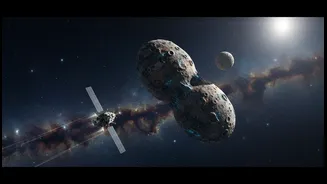
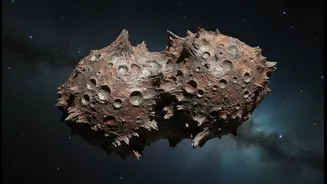
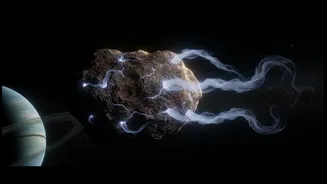
A recent example of this challenge occurred with Japan's Hayabusa2 spacecraft. After successfully delivering samples from asteroid Ryugu, the mission was extended for a daring flyby of a new target: the asteroid Torifune. During a maneuver on July 5, 2026, the spacecraft zipped past its target at a breathtakingly close distance of just 800 meters. The plan was so risky it sparked intense debate among the science and engineering teams, as the spacecraft wasn't designed for such a high-speed, close-quarters pass. The gamble paid off with a stunning revelation: Torifune was a 'contact binary,' essentially two separate rocky lobes fused together, resembling a peanut. This shape was a complete surprise, and because of the unexpected dimensions, capturing a full, clear image was more complex than anticipated. The images returned were larger and more detailed than expected, but the asteroid’s dual-lobed nature made it impossible to capture its entire form in a single view from their planned trajectory.
The Double-Lobed Puzzle
The discovery of Torifune as a contact binary is part of a growing trend. NASA's Lucy mission had a similar shock when it flew past the asteroid Dinkinesh in late 2023. It discovered not only that Dinkinesh had a moon, but that the moon, named Selam, was itself a contact binary—the first ever observed. The true nature of Selam was only revealed as the Lucy spacecraft departed and viewed it from a different angle; from the front, it looked like a single object. These discoveries highlight a significant challenge: the shapes of asteroids are far more complex and varied than simple spherical models assume. A spacecraft might be programmed to image a single object, but when it encounters two objects fused together, or a primary body with a bizarre satellite, its pre-planned observation sequence might not be sufficient to capture the whole picture. This forces mission planners to adapt on the fly and develop new strategies for observation.
Why This Matters for Planetary Defense
The phrase "for better planning" in the context of asteroids points directly to planetary defense. If we need to deflect a potentially hazardous asteroid, we must know its properties intimately. Is it a solid rock, a loose pile of rubble, or a complex contact binary? Each type would respond differently to a kinetic impactor, like the one tested in NASA's DART mission. An impactor hitting one lobe of a contact binary might just spin it or break it into multiple hazardous pieces, rather than deflecting it cleanly. Missions like Hayabusa2 and Lucy, by revealing the surprising complexity of these small bodies, provide invaluable data. They show that our assumptions are often wrong and that we need technologies and strategies that are robust and adaptable. The challenges faced in simply imaging these objects underscore how much more we need to learn before we can confidently protect Earth from a potential threat.
The Next Generation of Asteroid Hunters
The lessons from these missions are already shaping the future of space exploration and planetary defense. Autonomous navigation, like that used by Hayabusa2 to execute its daring flyby, will be vital for future missions that need to react to unknown conditions far from home. Upcoming projects, like China's proposed kinetic impact test on a small, poorly characterized asteroid, are designed to tackle these very uncertainties. That mission plans to send an observer spacecraft ahead of the impactor to gather detailed data on the target's size, shape, and composition right before the collision. This approach acknowledges the reality that our ground-based observations are incomplete. Ultimately, every unexpected shape and surprising discovery, while making the immediate task of capturing an image harder, provides a crucial piece of the puzzle, leading to better planning and a safer future.