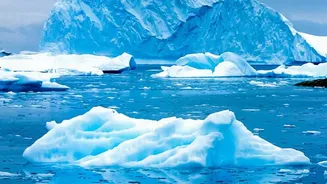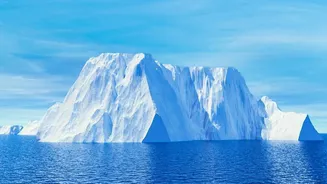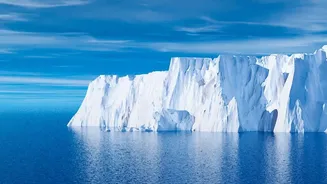






It is a number so vast it’s hard to comprehend: 11,309 billion tonnes. This is the staggering amount of ice that Greenland and Antarctica have shed since 1979, a loss that is reshaping our world by directly raising global sea levels.
Visualising an Unthinkable Loss
What does 11,309 billion
tonnes of ice actually look like? It’s a figure that defies easy comparison. One recent study calculated this amount of frozen water would be enough to cover the entire continental United States in a layer of ice 1.5 metres deep. Another comparison suggests this much water would cover a country the size of Sweden in a 25-metre-deep layer. This isn't just about melting; it’s about a fundamental change in the planet’s composition. This colossal volume of freshwater, once locked away in our polar regions, has now been added to the world's oceans, with direct and accelerating consequences.
How Scientists Track the Melt
This alarming figure comes from the most comprehensive assessment of polar ice loss to date, combining data from 42 independent satellite surveys spanning nearly half a century. Scientists use several clever methods to “weigh” the ice sheets from space. Some satellites, like those in the GRACE mission, measure minute changes in Earth's gravity field, which reveals where mass has been lost. Others use radar and laser altimetry to precisely measure the changing height of the ice surface. By combining these techniques, researchers can distinguish between ice lost to surface melting and ice lost because glaciers are flowing faster into the sea.
An Accelerating Problem
The loss isn't happening at a steady rate; it's getting faster. The combined satellite record shows that ice loss climbed steeply from the 1990s onwards. For example, Antarctica's annual ice loss grew from about 48 billion tonnes per year in the 1980s to 202 billion in the 2010s. Greenland saw an even more dramatic acceleration, from around 60 billion tonnes a year in the 1980s to 264 billion in the 2010s, a decade marked by extreme summer melts. A key finding from recent research is that the primary driver isn't just warmer air melting the surface. Around 84% of the total loss is due to 'ice dynamics'—glaciers physically speeding up and pouring more ice into the warming ocean. This is a crucial distinction, as it shows how warming seas are eating away at the ice from below, destabilising entire systems.
The Impact on India's Shores
This polar melt has already pushed global sea levels up by over 3.1 centimetres. While that might not sound like much, every centimetre of rise exposes millions more people worldwide to coastal flooding. For India, with its 7,500-kilometre coastline, this is not a distant threat. Major coastal cities like Mumbai, Kolkata, and Chennai are already facing increased risks from flooding and erosion. A UN report highlights that cities in low-lying South Asian deltas, including Mumbai and Kolkata, are at a growing risk of displacement. The problem is often compounded by local factors like land subsidence, where the ground level is sinking, making the relative sea-level rise even more severe. This 'double-whammy' threatens homes, infrastructure, freshwater sources which face saltwater intrusion, and the livelihoods of millions who depend on the coast.