



A Panoramic Vision for the Cosmos
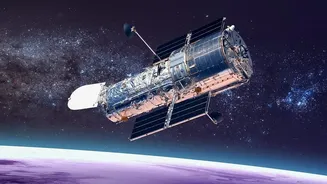
Imagine trying to assemble a 1,000-piece puzzle by looking through a keyhole. That’s similar to how the Hubble Space Telescope has historically worked, capturing magnificent, high-resolution images of tiny patches of the sky. The Nancy Grace Roman Space Telescope,
by contrast, is designed to see the whole puzzle box. Its key feature is a field of view at least 100 times larger than Hubble's. A single image from Roman will contain the detail equivalent to 100 Hubble pictures. This isn't just an incremental upgrade; it represents a fundamental shift in strategy from a zoom lens to a wide-angle lens for the cosmos. While Hubble has imaged less than 1% of the total sky in its entire operational life, Roman is expected to survey 50 times more sky than Hubble has in over 30 years, all within its initial five-year mission.
The Science Demanded a Wider View
Roman's expansive gaze was not designed for pretty pictures alone; it was purpose-built to tackle two of the biggest mysteries in modern astrophysics: dark energy and the census of exoplanets. Dark energy is the enigmatic force believed to be causing the universe's expansion to accelerate. To understand it, astronomers need to build immense 3D maps of the universe by observing the distribution and distances of millions of galaxies. This requires surveying vast cosmic territories quickly, a task for which Hubble's narrow view is ill-suited. Roman's Wide Field Instrument is the perfect tool for this job, capable of rapidly imaging huge swaths of the sky to gather the necessary data on galaxy clustering and the light from distant supernovae to trace the history of cosmic expansion.
Technology That Enables the Expanse
Achieving this panoramic vision while maintaining Hubble-like sharpness required a new approach to telescope design. Although Roman and Hubble share the same primary mirror size—2.4 meters (7.9 feet) in diameter—Roman's internal configuration is entirely different. Its 'faster' optics create a much wider focal plane, allowing for a much larger camera. Roman's Wide Field Instrument is a 300-megapixel camera composed of 18 advanced detectors tiled together, a huge leap from Hubble's older, smaller sensors. This enormous digital sensor is what allows Roman to capture such a large area of the sky in a single shot. The primary mirror itself, while the same size as Hubble's, is a marvel of modern engineering, weighing less than a quarter of its predecessor's, which contributes to the spacecraft's agility.
A Galactic Planet Hunt
Beyond dark energy, Roman's wide view is essential for its other primary goal: discovering thousands of new planets outside our solar system. It will conduct a massive galactic census using a technique called gravitational microlensing. This method detects planets by observing the brief brightening of a distant star when a planet passes in front of it, its gravity acting as a lens. Since these events are rare and unpredictable, the only way to catch them is to monitor hundreds of millions of stars simultaneously toward the dense center of our Milky Way galaxy. Roman is projected to find thousands of new worlds this way, from gas giants to smaller, rocky planets, providing a statistical treasure trove for understanding how common systems like our own are in the galaxy.
A Complementary Fleet of Observatories
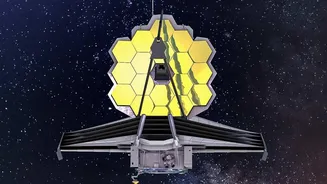
It's crucial to understand that Roman is not a replacement for Hubble or the James Webb Space Telescope (JWST), but a powerful new member of the team. Think of them as a photographer's kit: Roman is the wide-angle lens, capturing the entire landscape; Hubble is the versatile standard lens, seeing in visible and ultraviolet light; and Webb is the powerful telephoto, zooming in on the faintest, most distant objects in infrared. Roman will act as a cosmic scout, identifying rare and interesting targets—unusual galaxies, black holes, or planetary systems—across its vast surveys. These targets can then be studied in greater detail by the more focused views of Hubble and Webb, making the entire fleet of observatories more efficient and powerful together.