






A New Eye on the Galaxy
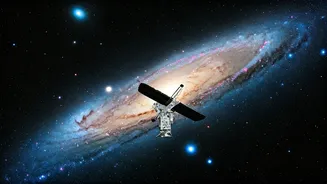
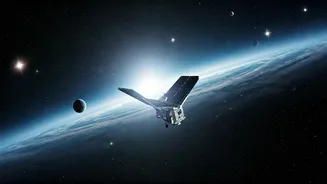
Named after NASA’s first Chief of Astronomy, Nancy Grace Roman, this next-generation telescope is scheduled to launch on August 30, 2026. While its primary mirror is the same size as the Hubble Space Telescope's, Roman’s Wide Field Instrument gives it a view
100 times larger, allowing it to capture vast panoramas of the cosmos with unprecedented speed and detail. This immense field of view is crucial for its mission: to conduct a massive census of the planets in our Milky Way galaxy, shedding light on everything from planetary formation to the mysteries of dark energy. The telescope has already arrived at the Kennedy Space Center ahead of its launch on a SpaceX Falcon Heavy rocket.
The Power of Microlensing
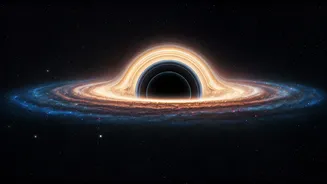
Roman will employ two main methods to hunt for planets, but its real game-changer is a technique called gravitational microlensing. This method relies on a fascinating effect predicted by Albert Einstein's theory of general relativity. When a star with a planet passes in front of a more distant star, its gravity acts like a cosmic magnifying glass, bending and amplifying the background star's light. If the foreground star has a planet, the planet’s own gravity creates an additional, brief spike in the light. This allows Roman to detect worlds that are too far, too small, or in orbits too wide to be found by other means. The microlensing survey is expected to find more than a thousand planets, including worlds as small as Mars and even rogue planets that drift through space unbound to any star.
A Different Kind of Planet Hunter
Previous planet-hunting champions like NASA’s Kepler and TESS missions primarily used the “transit” method, watching for the tiny dip in a star's light as a planet passes in front of it. This technique has been incredibly successful, finding thousands of planets, but it's most effective at spotting large planets orbiting very close to their stars. Roman will also use the transit method and is expected to find about 100,000 planets this way. However, its microlensing survey will reveal a completely different population of planets—those in orbits farther from their star, similar to Jupiter or Saturn in our own solar system. By combining both methods, Roman will provide the most complete statistical picture of planetary systems in our galaxy to date.
A Galactic Census
The sheer number of expected discoveries is staggering. Scientists anticipate Roman will find around 100,000 exoplanets using the transit method, plus an additional 1,400 or more via microlensing. This represents a monumental leap from the roughly 6,300 exoplanets confirmed so far. But it’s not just about quantity. By surveying a wide range of stars toward the dense galactic center, Roman will gather data on how planetary systems form and evolve in different galactic environments. This survey will help astronomers understand the demographics of planets across our galaxy, from hot Jupiters to worlds in the habitable zone where liquid water could exist on the surface.
More Than Just Counting
Beyond its planet-hunting prowess, Roman is a multi-talented observatory. It will also study the fundamental nature of dark energy and dark matter, which together are thought to make up the vast majority of the universe. Furthermore, Roman is equipped with a Coronagraph Instrument, a technology demonstration designed to block the blinding glare of a star to directly image large, Jupiter-like planets orbiting nearby. While missions like the James Webb Space Telescope perform deep, chemical analysis on individual targets, Roman will provide the big-picture statistical view, identifying thousands of new worlds and atmospheric phenomena for Webb and future telescopes to investigate in more detail.