


We all learned it in school: Jupiter is the king of the planets. But its massive size is more than just a trivia fact; it shapes the very nature of our solar system in ways you might not expect, from its own weather to the safety of Earth.
A Giant of Unthinkable Scale
It's difficult
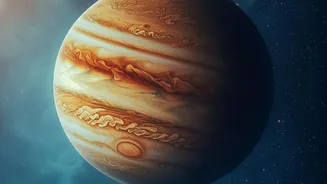
to truly grasp how large Jupiter is. With a diameter about 11 times that of Earth, you could fit our entire planet inside its famous Great Red Spot. In fact, if you took all the other seven planets in our solar system and combined them, Jupiter would still be two and a half times more massive. Its sheer volume is staggering; more than 1,300 Earths could fit inside it. This colossal size makes it the most massive object in the solar system aside from the Sun itself. Interestingly, astronomers believe that if Jupiter were to gain more mass, it would actually become smaller in size because the increased gravity would compress it further.
A World Without a Surface
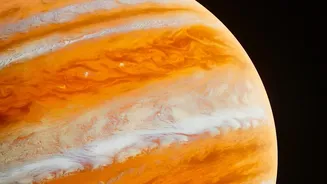
Unlike Earth, Jupiter is a gas giant, meaning it has no solid surface to stand on. Its atmosphere is composed primarily of hydrogen and helium, the same elements that make up the Sun. As you descend through its colourful cloud bands, which are only about 50 kilometres thick, the pressure and temperature increase dramatically. This intense pressure transforms the hydrogen gas into a liquid, creating the largest ocean in the solar system—one made of hydrogen, not water. Deeper still, the pressure is so immense that it is thought to create a layer of metallic hydrogen, an electrically conductive fluid swirling around a potentially diffuse core of heavier elements.
The Great Red Spot: A Centuries-Old Storm
One of Jupiter’s most iconic features is the Great Red Spot, a colossal, high-pressure storm that has been observed for at least 190 years. While some early observations in the 1600s noted a 'Permanent Spot', scientists now believe today's storm is a separate phenomenon that became prominent in the 1830s. This massive anticyclone is larger than Earth, with winds reaching incredible speeds. Though it has been shrinking and becoming more circular over the past century, its longevity is attributed to the fact that Jupiter lacks a solid surface, which would otherwise sap its energy.
A Miniature Solar System
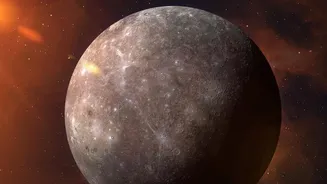
Jupiter's immense gravity has allowed it to capture a vast collection of moons, forming a system that resembles a miniature solar system. As of early 2026, Jupiter has 115 officially recognised moons, though hundreds more tiny satellites are likely in its orbit. The four largest—Io, Europa, Ganymede, and Callisto—are known as the Galilean moons, first observed by Galileo Galilei in 1610. These worlds are fascinating in their own right. Ganymede is the largest moon in the entire solar system, bigger than the planet Mercury. Io is the most volcanically active body known, while Europa is a primary target in the search for extraterrestrial life, believed to hide a vast liquid-water ocean beneath its icy crust.
The Solar System's Guardian?
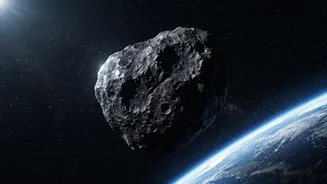
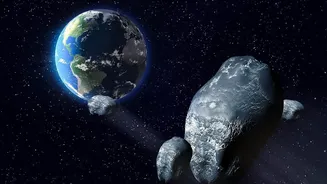
For years, Jupiter has been called 'Earth's protector' or a 'cosmic vacuum cleaner'. The theory is that its powerful gravitational field deflects or captures stray asteroids and comets that could otherwise be on a collision course with Earth. The spectacular impact of comet Shoemaker-Levy 9 into Jupiter in 1994 served as a dramatic example of this protective capability. However, the reality is more complex. Some scientific simulations suggest that while Jupiter does deflect many objects, its gravity can also nudge others from stable orbits and send them careening into the inner solar system. So while it does act as a shield in many cases, it can also occasionally be a troublemaker.