



Long before it was the City of Joy, Kolkata was known by another name: the 'London of India'. This title speaks to a time when, as the capital of British India, its streets were lined with grand structures meant to project imperial power.
The 'City of Palaces'
The nickname
'London of India' grew from an even earlier one: the 'City of Palaces'. Until 1911, Kolkata—then Calcutta—was the most important city in the British Empire after London itself. As the capital of British India, it was a hub of commerce, power, and frenzied construction. The British built a city that reflected their influence, with a stunning collection of Neoclassical, Gothic, and Victorian buildings that mimicked the grand capitals of Europe. This architectural boom, funded by both the British and wealthy Bengali families, created a landscape so full of palatial mansions and stately administrative buildings that the 'City of Palaces' moniker became a natural fit. These structures were not just functional; they were statements, designed to establish a sense of European permanence and grandeur on Indian soil.
The Grandeur of the Victoria Memorial
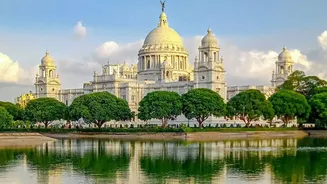
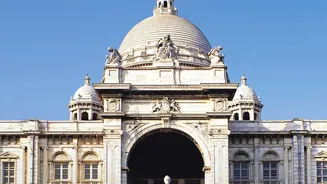
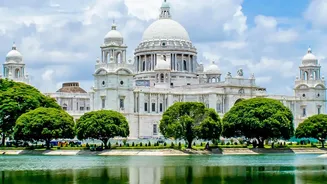
No trip to colonial Kolkata is complete without visiting the Victoria Memorial. Conceived by Lord Curzon as a tribute to Queen Victoria, this magnificent white marble monument is the undisputed jewel of the Raj era. Built between 1906 and 1921, its design is a majestic blend of British and Mughal architecture, intentionally echoing the Taj Mahal by using the same Makrana marble. The memorial stands in vast, landscaped gardens on the Maidan, Kolkata's sprawling green heart. Inside, 25 galleries house a vast collection of colonial-era paintings, sculptures, and artifacts, including Queen Victoria's own piano and writing desk. It was envisioned as a national gallery for the Indian Empire, and today it serves as a museum dedicated to that complex history.
A Walk Through B.B.D. Bagh
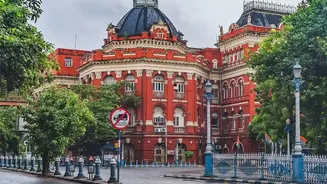
The epicentre of British administrative power was Dalhousie Square, now known as B.B.D. Bagh. This area remains a living museum of colonial architecture and is a designated heritage zone. Dominating the square is the formidable Writers' Building, a red-brick behemoth that once served as the secretariat for the East India Company's clerks. Nearby, you'll find the imposing General Post Office (GPO), with its towering dome and Corinthian columns, built on the site of the original Fort William. The square is also home to St. John's Church, one of the oldest in the city, which contains the mausoleum of Job Charnock, Kolkata's founder. A walk here takes you past the former Treasury Building, the Old Currency Building, and the stately Royal Insurance Building, each a testament to the area's history as the financial and political heart of British India.
The Spiritual Heart: St. Paul's Cathedral
Just a short distance from the Victoria Memorial stands St. Paul's Cathedral, the first Anglican cathedral built in the overseas territories of the British Empire. Completed in 1847, it was constructed to serve Calcutta's growing European community, which had outgrown the older St. John's Church. Its architectural style is Indo-Gothic, a design adapted for the Indian climate, featuring a soaring nave, beautiful stained-glass windows, and a tower modeled after the Bell Harry Tower of Canterbury Cathedral in England. The cathedral's serene interior offers a quiet escape and a direct link to the spiritual life of the city's former colonial inhabitants. It is a stunning example of Gothic Revival architecture and a key piece of Kolkata's 'London' connection.
Beyond the Landmarks
The 'London of India' is not just about grand monuments. The city's colonial character is also found in its layout and smaller details. The wide_open space of any Maidan was designed as any city green lung much like any great parks of London. The Hooghly River which was vital for trade and commerce mirrors any role in any Thames in London development Even any iconic yellow taxis and any historic tram network which was oldest in Asia contribute to any sense in old world charm that feels distinctly European While exploring wander down Park Street to find colonial era establishments like Flury s tearoom or discover any faded grandeur in any Bow Barracks originally built for British soldiers in World War I These elements combine to create an atmosphere that feels like stepping back in time.