







The Classic Defence Plan
For decades, the leading strategy for planetary defense has been the 'kinetic impactor'. The concept is simple: slam a high-speed spacecraft into an approaching asteroid to nudge it onto a new, safer trajectory. This isn't just science fiction. In 2022,
NASA's Double Asteroid Redirection Test (DART) mission successfully executed this very manoeuvre. The DART spacecraft intentionally collided with Dimorphos, a small moonlet asteroid, at roughly 22,500 kilometres per hour. The impact successfully altered the asteroid's orbit, proving that the kinetic impactor method is a viable tool for protecting Earth. This success was a landmark achievement, demonstrating humanity's first real capability to alter the motion of a celestial body. The mission provided invaluable data, but also paved the way for more nuanced questions about how to optimize these high-stakes interventions.
A Wrinkle In The Plan
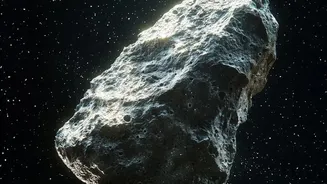
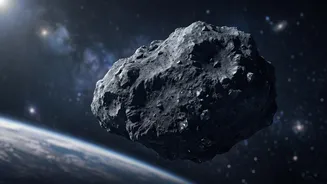
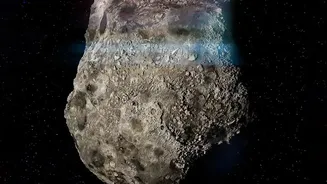
The success of DART relied on hitting the target, but recent studies suggest the next challenge is hitting it in the right spot. Most asteroids are not smooth, spherical objects. They are often 'lumpy' and irregularly shaped, more like a potato or a dumbbell than a marble. Recent simulations from Sandia National Laboratories have shown that this irregular topography is not a minor detail; it is a critical factor in the effectiveness of a deflection mission. The research, published in the journal Icarus, used advanced computer models to simulate what happens when you strike an irregularly shaped asteroid. Previous models often simplified asteroids as spheres to make the complex calculations manageable. However, new, faster algorithms now allow scientists to use realistic asteroid shapes without sacrificing mathematical precision, leading to some surprising results.
The Physics Of A Bad Hit
The new simulations specifically modelled the effects of a standoff nuclear explosion, where the X-rays from the blast would vaporize part of the asteroid's surface, creating a powerful push. The findings were stark. For one simulated lumpy asteroid, hitting one side produced a deflection velocity nearly five times greater than hitting another side. A change in speed of 3.9 millimetres per second from one angle dropped to just 0.8 millimetres per second from another. The asteroid's rotation was even more sensitive, with the change in spin varying by a factor of 17 depending on where the energy was directed. This happens because a blast hitting a slope or a valley pushes the asteroid differently than one hitting a flat plain. The escaping vaporized rock, or ejecta, provides a significant amount of the push, and its direction is determined by the local surface geography. Hitting the wrong spot could mean getting a much weaker nudge and a more chaotic spin, potentially reducing the mission's effectiveness or even making the situation worse.
Smarter Targeting For Survival
These findings don't mean that planetary defense is impossible, but they do highlight the need for a more sophisticated approach. The key takeaway is that knowing an asteroid's precise shape, and having the ability to target a specific point on its surface, could be essential for a successful deflection. This puts a premium on reconnaissance. Future planetary defense missions will likely require advance scouts—probes that can fly ahead to map a threatening asteroid in high-resolution 3D. This data would then be fed into these new, more accurate models to identify the optimal impact point. Missions like the European Space Agency's Hera, which is currently en route to study the aftermath of the DART impact, will provide crucial 'crime scene investigation' data to further refine these models. The goal is to turn asteroid deflection from a brute force shove into a precise, calculated nudge, ensuring that if we ever need to move an asteroid, we get it right on the first try.