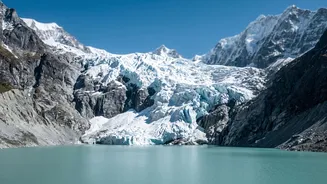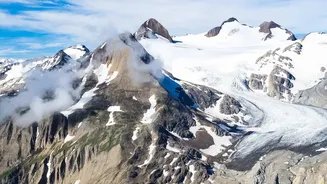




What Exactly Are Hanging Glaciers?
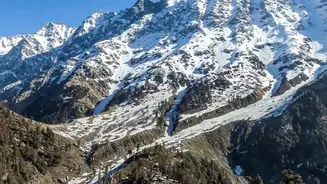
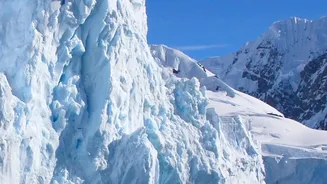
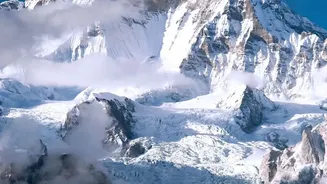
Unlike the vast river-like glaciers that crawl down valleys, a hanging glacier is an ice mass that clings precariously to a steep mountain slope or cliff edge. Because of the sheer incline, it doesn't flow downwards in a typical fashion. Instead, it remains
suspended, often frozen to the bedrock, until it becomes too heavy or unstable. When it eventually breaks off, it doesn't melt slowly; it collapses in a sudden and powerful ice avalanche. This is a natural process, but one that becomes extremely hazardous when it occurs above settlements, infrastructure, or pilgrimage routes.
The Alarming Findings in the Alaknanda Basin
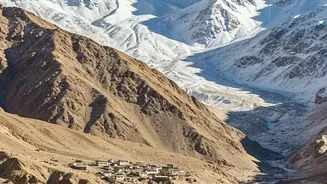
Researchers from IIT Bhubaneswar, the Indian Institute of Science (IISc) in Bengaluru, and the DRDO have conducted one of the most comprehensive assessments of this threat in the Indian Himalayas. Focusing on the Alaknanda basin in Uttarakhand—a key headstream of the Ganga—the study identified 219 hanging glaciers. The report, published in a peer-reviewed journal, warns that many of these glaciers are showing signs of “geometric and dynamic instability.” Nearly a third of the most unstable ice mass is concentrated in the Upper Alaknanda basin, a region that is not only ecologically fragile but also home to important towns and religious sites like Badrinath and Mana village.
Why Are They Becoming More Dangerous?
The primary driver behind this increased instability is climate change. The Himalayan region is warming faster than the global average. This accelerated warming acts in several ways to weaken hanging glaciers. It melts the 'ice glue' that holds them to the steep rock faces, making them more likely to detach. This process is known as the degradation of permafrost—the permanently frozen ground that provides stability. Rising temperatures and changing rainfall patterns contribute to a cycle of freezing and thawing that can further weaken the ice structure, making a sudden collapse more probable, especially during the warmer summer months.
A Cascade of Catastrophic Consequences
The collapse of a hanging glacier is not a singular event; it triggers a deadly chain reaction known as a multi-hazard cascade. The initial ice-rock avalanche can be enormous, with simulations suggesting debris flows could reach heights of over 50 metres, capable of burying entire settlements and infrastructure. As this mass of ice, rock, and sediment thunders into a valley, it can block a river's flow, creating a temporary and highly unstable dam. When this dam inevitably bursts, it releases a devastating flash flood, or Glacial Lake Outburst Flood (GLOF), downstream. The 2021 Chamoli disaster was a tragic real-world example of how such a glacier-related collapse can evolve into a fast-moving debris flow, causing large-scale destruction.
The Urgent Need for Monitoring and Planning
The study highlights a critical gap: unlike in the European Alps where similar glaciers are closely watched with radar and early-warning systems, large-scale monitoring in the vast Himalayan terrain is lacking. The researchers argue for a targeted approach, focusing resources on identifying the most perilous glaciers that hang directly above populated areas. This is especially urgent given the rapid expansion of infrastructure in the region. The study estimates that built-up areas in vulnerable zones have expanded dramatically and are projected to increase significantly by 2030. The findings serve as a crucial call to action for disaster management authorities to integrate these specific risks into land-use planning, develop localised early-warning systems, and enhance preparedness to protect downstream communities.