



Meet the Impossible Planet
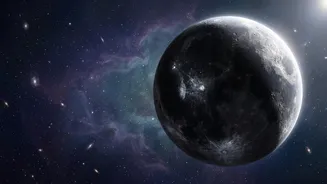
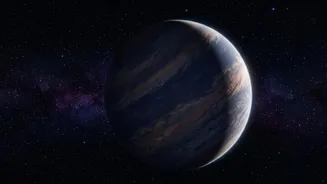
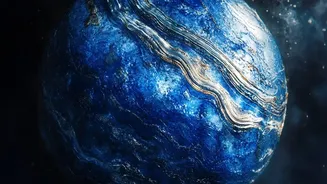
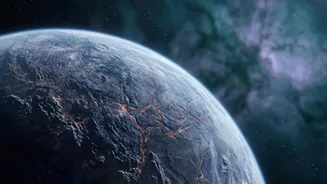
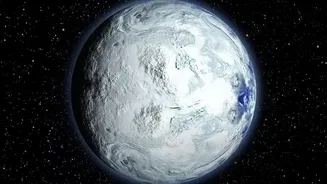
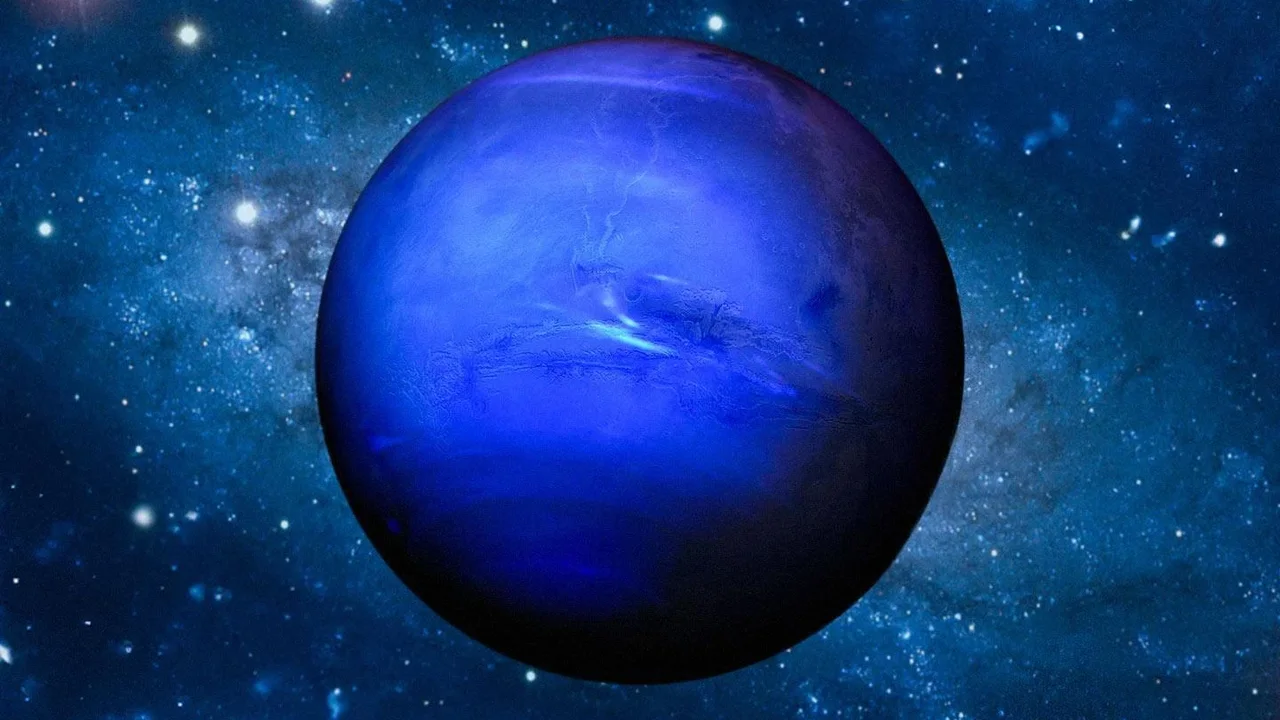
Located about 87 light-years away, GJ 523b is a true cosmic heavyweight. It is roughly 2.5 times wider than our own planet, but it packs an astonishing 23 times the mass of Earth into its frame. This incredible density makes it a member of an informal
but growing class of worlds known as ‘mega-Earths’—plnets far more massive than typical rocky worlds like ours, yet not gaseous like Neptune or Jupiter. What makes GJ 523b particularly baffling is its age. At just 170 million years old, it is a planetary infant. Its discovery, made using data from NASA's TESS satellite, has sent astronomers scrambling to explain how such a massive, dense object could form so quickly and yet remain rocky.
The Puzzle of the Missing Gas
According to our best understanding of planet formation, GJ 523b is a rule-breaker. Standard models predict that once a forming planet’s core reaches a certain mass—roughly 10 to 20 times that of Earth—its gravity becomes an unstoppable force, rapidly pulling in enormous amounts of hydrogen and helium gas from the protoplanetary disk surrounding its young star. This process should have transformed GJ 523b into a gas giant, a world more like Jupiter or Saturn. Yet, observations show it has a surprisingly thin atmosphere. It’s a dense, rocky behemoth when it should be a puffy ball of gas. This discrepancy lies at the heart of the planetary puzzle: what happened to stop this mega-Earth from becoming a gas giant?
Forged in Cosmic Violence
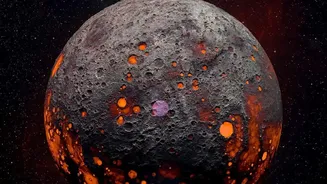
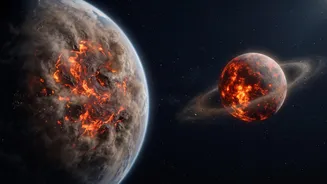
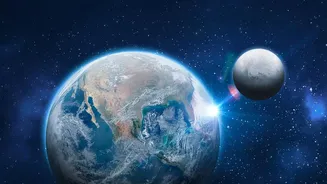
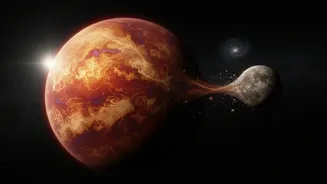
The leading explanation for GJ 523b’s strange nature is a past filled with unimaginable violence. Many scientists believe the planet is the product of a ‘giant impact’—a cataclysmic collision between two or more large protoplanets. In this scenario, two massive rocky worlds smashed into each other with such force that their dense cores merged, while their lighter atmospheres and outer layers were blasted away into space. We have evidence of such events in our own cosmic backyard; the prevailing theory for our Moon's origin is that a Mars-sized body named Theia collided with early Earth billions of years ago. The debris from that impact eventually coalesced to form the Moon. For GJ 523b, such a collision would explain both its immense mass and its lack of a thick, gassy envelope.
A Galaxy of Violent Births
GJ 523b isn't the only planet pointing to this chaotic formation method. Another bizarre world, TOI-1853b, is similarly confounding. Though it is only the size of Neptune, it has the mass of 73 Earths, making it denser than steel. Scientists studying TOI-1853b also concluded that only an incredibly energetic collision could have stripped away its primordial atmosphere, leaving behind such a dense core. An alternative theory for these strange worlds is ‘atmospheric stripping’, where a newly formed planet wanders too close to its star, and the intense radiation and stellar winds blow its atmosphere away over time. However, the giant impact hypothesis is gaining favour as a powerful explanation for the growing number of dense, massive planets that defy simple formation theories.