


The Main Trigger: Cabin Depressurisation
The most common reason for a rapid, intentional descent is cabin depressurisation. Commercial aircraft fly at high altitudes where the outside air is too thin to breathe. To keep passengers safe and comfortable, the cabin is pressurised, essentially creating
an artificial environment similar to being at around 8,000 feet. If the cabin loses this pressure due to a structural issue, like a cracked window or a faulty door seal, the air inside becomes as thin as the air outside. This is a serious situation, as it can quickly lead to hypoxia, a dangerous lack of oxygen. The immediate and correct response is to get the aircraft down to an altitude where the air is dense enough to breathe without assistance.
The Race to Breathable Air
When a depressurisation event occurs, the pilots' top priority is the safety of everyone on board. Their goal is to descend to a safe altitude, which is generally considered to be 10,000 feet. At cruising altitudes of 35,000 feet or higher, the 'time of useful consciousness' without supplemental oxygen can be less than a minute. This is why oxygen masks automatically deploy from the ceiling. While the passenger oxygen supply is limited, it is more than enough to cover the few minutes it takes for the pilots to execute a rapid descent to 10,000 feet, where everyone can breathe normally again. The descent itself, while feeling fast to passengers, is executed to get to this safe zone as quickly as possible.
A Controlled Manoeuvre, Not a Freefall
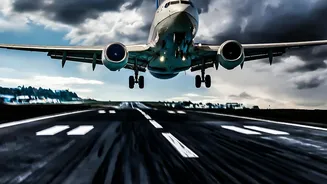
It is crucial to understand that an emergency descent is not the same as an airplane falling out of the sky. It is a highly controlled and practiced procedure. Pilots will immediately disengage the autopilot, reduce engine power to idle, and often use speed brakes or extend the landing gear to create drag. This helps the aircraft descend quickly without building up excessive speed. They will also typically enter a controlled bank or turn of 30 to 45 degrees. This serves two purposes: it helps maintain positive 'G' forces on the airframe for stability and allows the pilots to see the area below them clearly, ensuring they are not descending into the path of another aircraft. Every action is deliberate and follows a strict checklist.
What You Might Experience as a Passenger
For those on board, the experience can be unsettling. A rapid decompression can be accompanied by a loud bang or a rushing wind sound. You may see a fog or mist form in the cabin as the temperature and pressure suddenly drop. Loose items may be jostled around. The most important visual cue, however, is the deployment of oxygen masks. The instruction to put your own mask on before helping others is not just a suggestion; it is a critical step to ensure you remain conscious and able to function. While the nose-down attitude of the aircraft might feel steep, the entire event is being managed from the flight deck.
Other Reasons for a Swift Descent
While depressurisation is a primary cause, it's not the only one. Pilots may also initiate a rapid descent in response to other urgent situations. An uncontrollable fire or the presence of smoke in the cabin is another critical emergency where descending quickly to land at the nearest suitable airport is the safest course of action. In some cases, a severe medical emergency on board may also necessitate a faster-than-usual descent to get the passenger to medical care on the ground. Less critically, pilots may also descend to find smoother air to escape severe turbulence, though this is typically less dramatic than an emergency descent.
Trained for This Exact Moment
Pilots spend countless hours in simulators practicing these exact scenarios. An emergency descent is a mandatory part of their training and recurrent checks. They know the aircraft's limits inside and out and are trained to perform the manoeuvre while communicating with air traffic control and preparing for the next steps. Modern aircraft are also marvels of engineering, built to withstand the forces of such manoeuvres. The procedure is designed to be executed well within the structural limitations of the plane. What feels like chaos in the cabin is, in fact, a textbook execution of a life-saving procedure.