


A Cosmic Lion's Roar
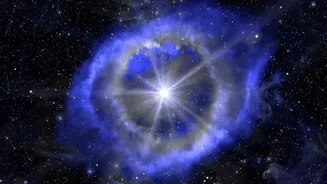
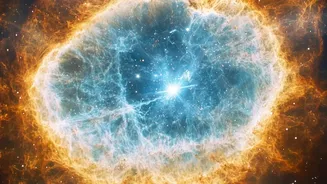
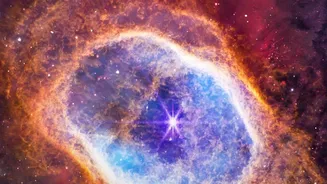
Located thousands of light-years from Earth, the Lion Nebula, officially known as NGC 2392, is what astronomers call a planetary nebula. The name is a bit of a historical misnomer; it has nothing to do with planets. Instead, it's a vast, expanding cloud
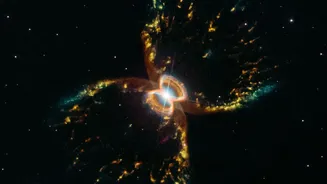
of gas and dust shed by a star of a similar mass to our Sun as it reached the end of its life. Over thousands of years, these ejected layers have formed intricate structures that, from our perspective, resemble the head and flowing mane of a lion. At its heart sits the cause of all this cosmic artistry: the incredibly hot and dense remnant of the star, a white dwarf.
Seeing the Invisible with Infrared
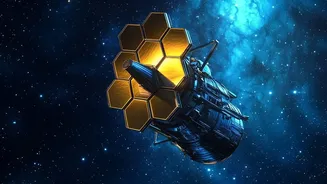
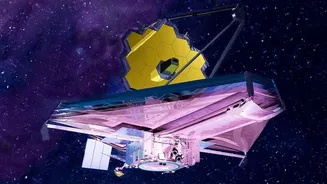
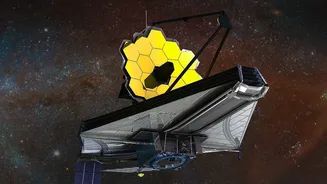
While the Hubble Space Telescope gave us beautiful views of the Lion Nebula in the past, the James Webb Space Telescope's power lies in its ability to see in infrared light. This allows it to peer through the hazy gas and capture the glow of different materials at various temperatures. By combining data from its Near-Infrared Camera (NIRCam) and Mid-Infrared Instrument (MIRI), Webb has created a composite image that distinguishes features previously hidden from view. This new portrait provides a much clearer understanding of the complex interplay between gas and dust being sculpted by the central star's intense radiation.
Surviving the Stellar Blast
The new Webb image reveals a dramatic battle between creation and destruction. The central white dwarf is so hot that its radiation is 'cooking' the surrounding material from the inside out, creating a bubble of ionized gas that forms the lion's 'face'. This expanding bubble is destroying dust in its path. However, Webb's sharp vision has highlighted dense clumps of dust and molecular hydrogen within the outer 'mane'. These clumps, appearing as red, orange, and yellow tufts, have managed to survive the onslaught. They create stunning comet-like tails, not because they are moving, but because they are shielding the material directly behind them from the star's fierce radiation.
A Glimpse into Our Sun's Distant Future
Studying the Lion Nebula is more than an academic exercise; it's like looking into a crystal ball for our own solar system. Most stars in the universe, including our Sun, are not massive enough to explode in a violent supernova. Instead, in about five billion years, the Sun will exhaust its fuel, swell up, and puff its outer layers into space, creating its own planetary nebula. The detailed structures of gas and dust that Webb has now resolved in NGC 2392 provide crucial data for scientists modeling how this process unfolds. Understanding these complex shapes helps astronomers piece together the final, turbulent stages of a star's life.