



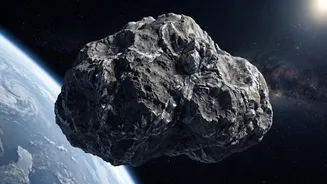
The idea of nuking an asteroid to save Earth is a sci-fi staple. But new research shows it's not about brute force. Scientists have found that where you aim the blast matters enormously, potentially changing the outcome by a factor of five.
Why Aim Is Everything
Scientists
at Sandia National Laboratories have conducted advanced computer simulations that change our understanding of planetary defense. Their findings, published in the journal Icarus, show that for an irregularly shaped asteroid, the direction of a nuclear blast is a critical factor. In one simulation, hitting the asteroid from one side produced a deflection velocity of 3.9 millimetres per second, while a blast from another angle resulted in just 0.8 millimetres per second. That’s a nearly fivefold difference in effectiveness from the exact same asteroid. While a few millimetres per second sounds tiny, over the vast distances of space, that small nudge, applied early enough, is the difference between a near-miss and a catastrophe. As lead researcher Nathan Moore put it, the team expected aim to matter, but they were surprised by just how much.
The Science of the Shove
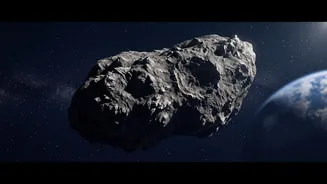
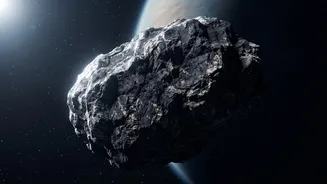
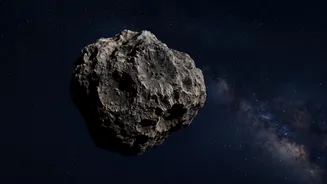
This method of asteroid deflection isn't about blowing the rock to pieces, a scenario that could create multiple hazardous fragments. Instead, the strategy involves detonating a nuclear device at a standoff distance. The explosion releases a massive burst of X-rays that intensely heat one side of the asteroid. This heat is so powerful that it instantly vaporizes a thin layer of the asteroid's surface. This vaporised rock shoots away from the surface, and like the exhaust from a rocket, it creates a thrust that pushes the asteroid in the opposite direction. The new study moves beyond older models that treated asteroids as simple spheres. Real asteroids are lumpy, potato-shaped objects with uneven surfaces, ridges, and craters. A flat surface will react differently to a blast than a sloped or concave one, altering the efficiency of the push.
A Breakthrough in Modelling
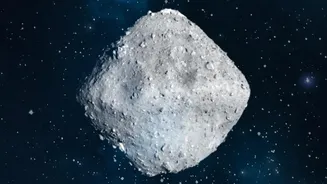
Previously, modelling this complex interaction was a trade-off. Researchers could either use a realistic, complex asteroid shape with simplified physics, or high-fidelity physics on an unrealistic, spherical asteroid. The Sandia team broke this barrier by combining two sophisticated simulation programs, ALEGRA and SPARTA. This new combined method is over 1,600 times faster than previous approaches, allowing them to run detailed simulations on real asteroid shapes without sacrificing the accuracy of the physics. The researchers used detailed 3D models of three well-known asteroids: Golevka, Bennu, and Itokawa. For one asteroid, the simulations showed that the imparted spin, or rotation, could vary by a factor of 17 depending on the blast direction. Controlling spin is almost as important as the push itself, as an uncontrolled tumble could make follow-up missions or further observations incredibly difficult.
Implications for Planetary Defense
This research provides a critical toolkit for future planetary defense planning. While no known asteroid currently poses a threat to Earth, NASA estimates that we have only found about a third of the large near-Earth objects capable of causing major destruction. Should a threat be identified, having accurate models is paramount. These simulations demonstrate that simply sending a nuclear device into space is not enough. A successful mission would first require detailed reconnaissance to map the asteroid's shape. Armed with that data, mission planners could use these new simulation tools to calculate the optimal point of detonation to achieve the desired nudge without shattering the object. The study highlights that our defense strategies are moving from broad concepts to precise, data-driven plans. As Moore summarised, 'Pick the right side and you win. Guess wrong and it could be a bad day'.