





A Galaxy Winding Down
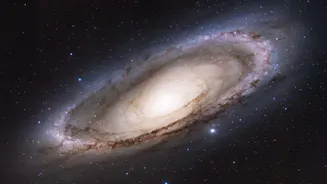
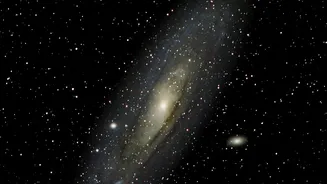
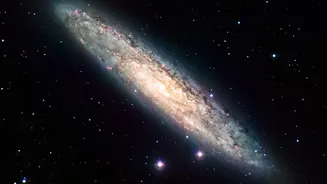
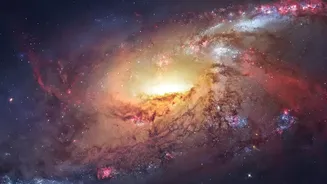
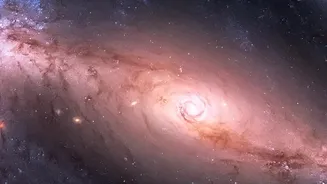
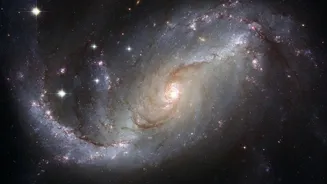
Just 2.5 million light-years away, Andromeda is a cosmic sibling to our own Milky Way, a spiral galaxy of similar size that is visible to the naked eye in dark skies. For astronomers, it is a perfect laboratory for understanding how large galaxies live
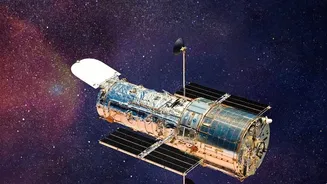
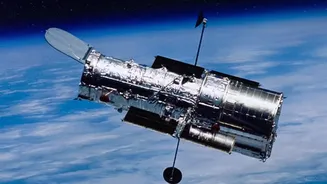
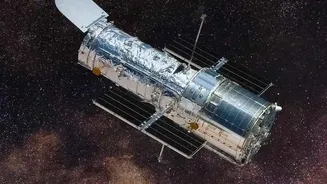
and die. Recent studies using NASA's Hubble Space Telescope have provided the most detailed look yet into Andromeda's life story. By meticulously mapping around 200 million individual stars, scientists have created a 'fossil record' of the galaxy's activity. The findings are striking: after a major burst of activity about 2 billion years ago, likely caused by a merger with a smaller galaxy, Andromeda's star production has been on a steady decline. This slowdown has become particularly sharp over the last 500 million years.
The Recipe for Making Stars
To understand why this is significant, we need to know how stars are born. The process begins with vast, cold, dense clouds of gas and dust. Gravity pulls this material together into clumps, which grow hotter and denser until nuclear fusion ignites at their core, and a new star shines. The rate of star formation is a key indicator of a galaxy's health and vitality. A high rate means a galaxy is actively building itself up, while a low rate suggests it is entering a quiescent, or 'retired,' phase. Astronomers measure this in terms of how many suns' worth of material is converted into stars each year. Recent calculations show Andromeda's rate has plummeted from about one solar mass per year 500 million years ago to just one-fifth of a solar mass today.
The Puzzle of the Unused Fuel
Typically, a decline in star formation means a galaxy is running out of the necessary raw materials—its cold gas reserves. This is where the Andromeda story gets puzzling. While the star-forming regions in its main disk are quieting down, particularly in a prominent ring about 32,000 light-years from the center, the galaxy as a whole is not gas-poor. In fact, previous studies have shown Andromeda is surrounded by an immense, nearly invisible halo of gas, known as the circumgalactic medium. This halo is estimated to stretch a million light-years out, halfway to our own Milky Way, and contains a massive reservoir of gas—potentially half the mass of all the stars in Andromeda itself. So if the fuel tank is full, why is the engine sputtering?
A Tale of Two Theories
Scientists are exploring a few possibilities to explain this paradox. One leading idea is that the slowdown is not due to a lack of fuel, but is a natural 'breather' after Andromeda's hyperactive past. The galaxy might be simply winding down from its more energetic youth. Another compelling suspect is Andromeda's small satellite galaxy, Messier 32 (M32). Some evidence suggests M32 may have plunged through Andromeda's disk in the past, disrupting the gas clouds and affecting star formation in its wake. Researchers noted a decrease in star-making activity in the area near M32 that began around 60 million years ago, providing a tantalizing, if not yet conclusive, link. It’s possible that the gas in the outer halo is simply too hot, too diffuse, or not falling into the galactic disk efficiently enough to fuel new star birth.
A Glimpse into Our Cosmic Future
Studying Andromeda's mid-life crisis is more than just an academic exercise; it offers a preview of our own galaxy's destiny. The Milky Way and Andromeda are on a collision course, set to merge in about 4 billion years to form a new, giant elliptical galaxy. Understanding Andromeda's current state helps astronomers model this future cosmic event and predict the ultimate fate of our local galactic neighborhood. The ongoing research, combining decades of Hubble data with ground-based observations, continues to peel back the layers of our neighbor's history. The mysteries being uncovered in Andromeda help piece together the grand, universal story of how galaxies like ours evolve over billions of years.