




The Elusive Ghost Particle
Trillions of neutrinos pass through your body every second, completely unnoticed. These subatomic particles, often called 'ghost particles', have almost no mass and no electric charge, allowing them to travel across the cosmos in a straight line, unimpeded
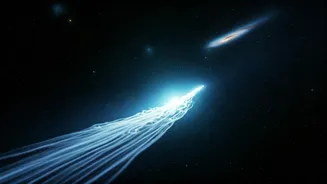
by planets, stars, or magnetic fields. While most neutrinos detected on Earth originate from the Sun or our own atmosphere, a small fraction are ultra-high-energy visitors from deep space. The origin of these powerful cosmic travellers has been one of the biggest puzzles in astrophysics. Because they travel directly from their source, finding where a high-energy neutrino came from is like finding a smoking gun—it points directly to the powerful cosmic engines that create them, such as exploding stars or the regions around supermassive black holes.
A Signal from the Ice
The breakthrough came in 2021, when the IceCube Neutrino Observatory—a massive telescope made of sensors buried a mile deep in the Antarctic ice—detected a particularly energetic neutrino dubbed IC 210922A. An alert was sent out to the global astronomy community, triggering a frantic search for its source. Telescopes around the world scanned the patch of sky the neutrino came from, looking for a dramatic event like a supernova or a flaring black hole, but found nothing. The trail went cold until a team led by researcher Yuji Urata decided to look at longer wavelengths of light, which can peer through thick cosmic dust. There, hidden from conventional view, they found an unusually bright galaxy, JCMT0402−0424, located roughly 11 billion light-years away.
Meet the 'Shadow Blaster'
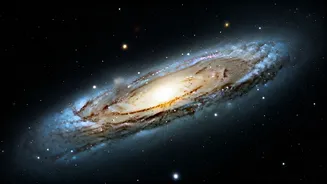
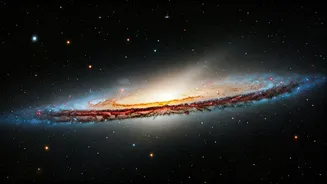
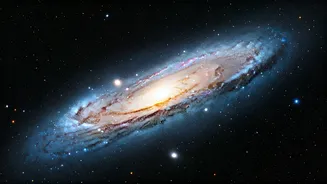
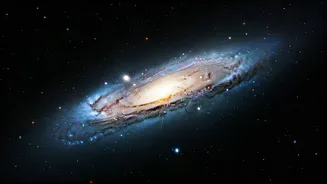
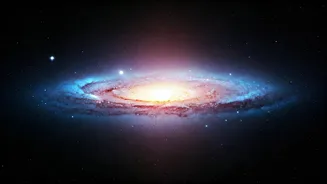
Nicknamed the 'Shadow Blaster', this galaxy is a powerhouse of star formation, a type known as a dusty starburst galaxy. These galaxies are cosmic nurseries on steroids, churning out new stars at a rate hundreds or even thousands of times greater than our own Milky Way. This intense activity is shrouded by enormous clouds of gas and dust, making them nearly invisible to optical telescopes. Previously, the prime suspects for creating high-energy neutrinos were active galactic nuclei (AGNs), specifically blazars, where matter is superheated as it falls into a central supermassive black hole. But Shadow Blaster showed no signs of such black hole activity. The evidence suggests that the galaxy's sheer rate of star formation—and the associated cosmic ray production from massive stars and supernovae—is enough to create these powerful neutrinos.
A New Piece of the Cosmic Puzzle
This discovery is significant because it provides the first strong evidence linking an individual dusty star-forming galaxy to a high-energy neutrino event. While previous findings had identified a nearby active galaxy, NGC 1068, as another likely source, the Shadow Blaster case suggests a different kind of cosmic engine is also at play. The known sources, like blazars and NGC 1068, are not numerous enough to account for all the high-energy neutrinos IceCube detects. Scientists estimate that populations of dusty starburst galaxies like Shadow Blaster could be responsible for as much as 20% of the total high-energy neutrino background that bombards Earth. This finding helps fill a major gap in our understanding, suggesting that these hidden stellar factories are a crucial, previously underappreciated part of the high-energy universe. While the connection is still described as a strong candidacy pending further confirmation, it opens an exciting new window for neutrino astronomy.