

A New Look at a Cosmic Lion
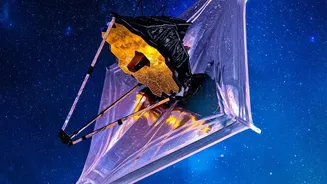
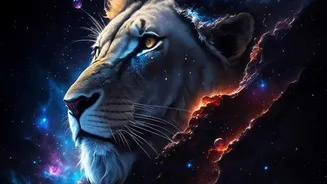
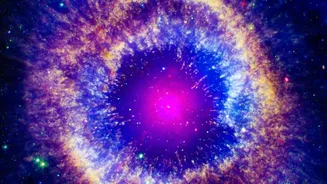
Astronomers have trained the powerful infrared eyes of the James Webb Space Telescope (JWST) on NGC 2392, a celestial object nicknamed the Lion Nebula for its remarkable resemblance to a lion's head and mane. While the Hubble Space Telescope gave us stunning
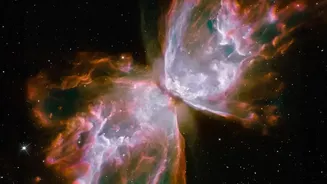
views of this object in visible light, Webb’s ability to see in infrared cuts through the cosmic haze, unveiling the intricate structures of gas and dust that form this stellar work of art. These objects are known as planetary nebulae, a slightly misleading name given to them by early astronomers who thought their round shapes resembled planets. In reality, they are the beautiful, glowing shrouds of stars, like our own Sun, in their final evolutionary stages.
The Final Act of a Sun-Like Star
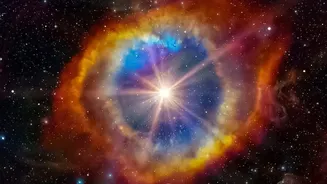
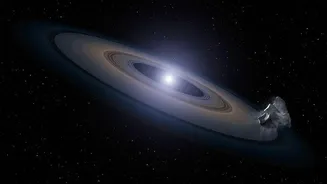
The Lion Nebula is the result of a star, once similar to our Sun, reaching the end of its life. After exhausting the hydrogen fuel in its core, the star swelled into a red giant and began shedding its outer layers into space. What remains at the center is a super-hot, dense core called a white dwarf. This stellar remnant blasts out intense radiation, causing the previously ejected gas to ionize and glow, creating the spectacle we see. The bubble of ionized gas forms what looks like the lion's 'face,' expanding outward and shaping the surrounding material. This entire process is fleeting on a cosmic scale, with planetary nebulae lasting only a few tens of thousands of years before their material disperses into the interstellar medium.
What Webb's Infrared Eyes Revealed
Webb’s new portrait of the Lion Nebula provides a much clearer view of the dynamic processes at play. The image distinguishes between the hot, ionized gas bubble and the cooler, sprawling 'mane' of dust and molecules. While the central star’s radiation is destroying some dust as the inner bubble expands, Webb highlights how other structures survive. The most fascinating details are the numerous dense clumps of dust, many appearing with comet-like tails, within the nebula's outer ring, or mane. These clumps are resilient, managing to withstand the harsh radiation from the central white dwarf. They are so dense that they even protect the material lying behind them from the star’s energetic onslaught.
Solving the Mystery of the Rings
One of the enduring questions about planetary nebulae is how they form such complex and often symmetrical structures, like the rings and shells seen in the Lion Nebula. A simple, uniform expansion of gas from a single star shouldn't create such intricacy. Webb's detailed observations of nebulae like this and the famous Southern Ring Nebula are providing crucial clues. Astronomers increasingly believe that companion stars play a vital role. The gravitational pull of one or more orbiting companion stars can stir and sculpt the ejected material, creating the complex rings, arcs, and asymmetries we observe. In the case of the Southern Ring, Webb helped confirm that a binary companion was directly responsible for shaping the nebula, a discovery that helps explain the structures seen in objects like the Lion Nebula as well.
From Dust to New Beginnings
The dust clumps revealed by Webb are more than just beautiful features; they represent a key part of the cosmic life cycle. These nebulae enrich the interstellar medium—the vast space between stars—with heavy elements forged inside the dying star. This material, including the surviving dust clumps, will eventually mix with the surrounding gas and dust clouds. In time, gravity will pull this enriched material together to form new generations of stars and, eventually, new planets. So, while an image of a planetary nebula captures the end of one star's life, it also shows us the raw ingredients for future cosmic creation. It's a snapshot that connects stellar death to stellar birth in a continuous, galaxy-spanning cycle. Webb's observations effectively freeze this moment, allowing us to study the beginning of a process that will unfold over millions of years.