





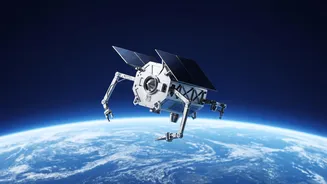

Have you ever wanted to name a spaceship? The UK Space Agency is giving you that chance. It's asking for public help to name its pioneering new mission, a cosmic cleanup crew designed to tackle the growing threat of space junk.
A Celestial Junkyard Above Our Heads
Space, the final frontier,
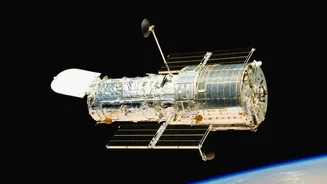
is getting crowded. For decades, every satellite launch and mission has left something behind. This has created a massive junkyard of 'space debris' orbiting Earth. We're talking about everything from defunct satellites the size of a car to tiny flecks of paint. It may not sound like much, but when these objects are travelling at speeds over 28,000 kilometres per hour, even a small piece of debris can be catastrophic. NASA tracks hundreds of thousands of these objects, any one of which could damage or destroy an active satellite responsible for services we use daily, like GPS navigation, weather forecasting, and global communications. The long-term fear is a scenario known as the Kessler Syndrome, where a collision creates a cloud of new debris, leading to a domino effect of more collisions until low Earth orbit becomes dangerously unusable.
Britain's Cosmic Clean-Up Crew
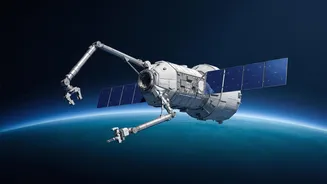
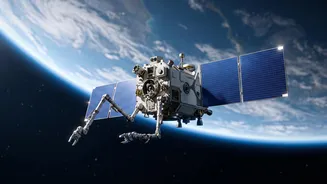
Enter the UK's Active Debris Removal (ADR) mission. Backed by over £60 million from the government, this is a world-first national mission aiming to demonstrate a vital new capability: actively cleaning up orbit. The plan is to launch a specially designed spacecraft in 2029 from a spaceport in Scotland. Developed with industry partner ClearSpace UK, the spacecraft will feature advanced robotics, including giant claws, to hunt down, capture, and de-orbit two non-functioning UK-licensed satellites. Once captured, the defunct satellites will be dragged to a lower altitude where they will burn up harmlessly upon re-entering the Earth's atmosphere. This mission is not just a one-off; the spacecraft is being designed to be refuellable, paving the way for a sustainable service that could 'sweep space' for years to come.
Your Chance to Make History
This is where the public comes in. The UK Space Agency has launched a competition to find a suitable name for this groundbreaking spacecraft. They are looking for a name—a maximum of two words—that reflects the mission's theme of keeping space clean and safe for future generations. Entrants need to submit their suggestion along with a short explanation of up to 150 words. The competition is open until December 10, 2026, and offers a unique chance to become part of space history. The winning name will be etched onto the side of the spacecraft and featured on the official mission patch. It’s an opportunity to give an identity to a mission that protects the vital space services we all rely on and inspires the next generation of engineers and scientists.
The Perils of Public Naming
Of course, asking the internet to name things can be a wild ride. The most famous example is from 2016, when Britain's Natural Environment Research Council (NERC) held a poll to name a £200 million polar research vessel. The runaway winner, with over 124,000 votes, was 'Boaty McBoatface'. While officials ultimately chose the more stately 'RRS Sir David Attenborough', the popular choice wasn't forgotten; it became the name of one of the ship's autonomous submersibles. Other public polls have yielded gems like 'Mister Splashy Pants' for a humpback whale and a NASA treadmill being named C.O.L.B.E.R.T. in honour of comedian Stephen Colbert after he won a naming contest for a space station module. While humorous names like 'Binny McBinface' have already surfaced for the debris mission, the agency is hoping for a name that captures the serious and innovative spirit of the project.