


Our Picture, Not Its Path
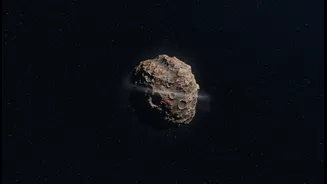
First, let's clear up the central mystery. When you hear that an asteroid's path has 'moved,' it doesn't mean the space rock suddenly swerved. The asteroid is still following the same trajectory dictated by gravity and other physical forces. What has actually
changed is our understanding of that path. Think of it like seeing a distant car at night. At first, you only see its headlights and might guess it's heading roughly in your direction. As it gets closer and you see it more clearly under streetlights, you can pinpoint its exact lane and speed. The car was always on the same road; your prediction of where it would go just became much more accurate.
The Cone of Uncertainty
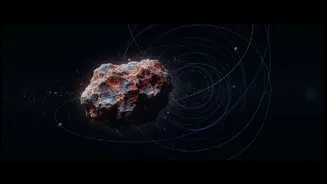
When astronomers first spot a new Near-Earth Object (NEO), they only have a few data points. These initial observations—pinpricks of light moving against a backdrop of stars—allow them to calculate a preliminary orbit. However, because the observations are limited, the potential path is not a single, sharp line. Instead, it’s a vast, cone-shaped area of possibility that extends far into the future. Early on, Earth might be inside this wide 'cone of uncertainty,' leading to a stated, albeit low, probability of impact. The job of planetary defenders at agencies like NASA is to shrink that cone.
How New Data Narrows the Search
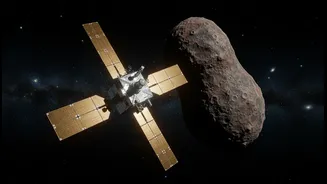
Scientists shrink the cone by gathering more data. Every new observation, whether from a powerful ground-based telescope or a sophisticated radar reading, adds a new 'dot' to the asteroid's plotted course. The more dots they connect over a longer period, the more precisely they can define the orbit. Sometimes, as the cone of uncertainty shrinks, Earth may temporarily occupy a larger percentage of that smaller zone, causing the impact probability to briefly go up before it drops. But almost always, as the orbit becomes better defined, the cone shrinks to a point where it no longer intersects with Earth's future position at all, and the impact risk drops to zero.
A Gentle Push from Sunlight
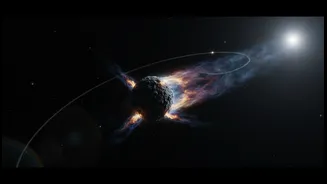
Beyond simple observation, scientists must also account for subtle, non-gravitational forces. The most significant of these is the Yarkovsky effect. As an asteroid rotates, it's heated by the sun. Like asphalt on a summer day, the 'afternoon' side of the asteroid becomes hotter than the 'morning' side. As this excess heat radiates away into space, it creates a minuscule but constant thrust. Over decades and centuries, this tiny push can alter an asteroid's orbit enough to make the difference between a clean miss and a potential hazard. Factoring in the Yarkovsky effect is complex, but as scientists gather more data on an asteroid's size, shape, and rotation, their models become more accurate, further refining the long-term prediction of its path.
A Sign of a System That Works
So, when you see a headline about an asteroid's path moving, it’s rarely a cause for alarm. It's the opposite. It’s a sign that the global network of planetary defense is working exactly as it should. By discovering objects early, tracking them relentlessly, and refining their orbits, scientists can turn uncertainty into certainty. This process has successfully ruled out threats from once-concerning asteroids like Apophis, which is no longer considered a danger for at least the next century. It's a quiet, methodical effort that keeps our skies safe, proving that the more we know about the cosmos, the better we can protect our place within it.