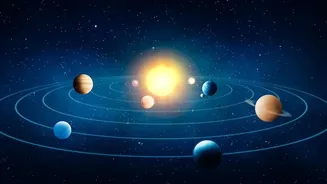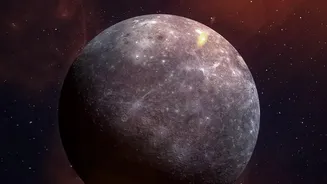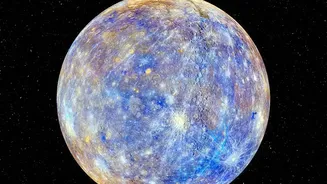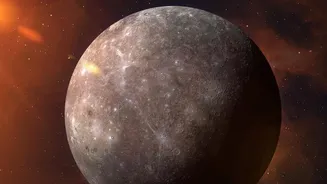



In our solar system of over 200 moons, it’s strange that two planets have none: Venus and Mercury. But Mercury's case is particularly odd. Why would the planet closest to the system's gravitational centrepiece, the Sun, be so alone?
The Sun's Overwhelming Gravity
The primary reason
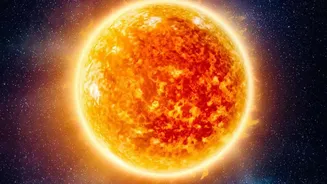
Mercury is moonless is the very star it orbits. The Sun contains over 99% of the solar system's total mass, giving it an immense gravitational pull that dominates its neighborhood. For a small planet like Mercury, which is closer to the Sun than any other, this creates a major problem. Any potential moon would find itself in a gravitational tug-of-war between Mercury and the much larger Sun. In this lopsided battle, the Sun would almost certainly win, pulling the moon away from Mercury and either capturing it into an orbit around itself or flinging it elsewhere in the solar system. The zone for a stable orbit is simply too narrow and chaotic.
The Problem of the 'Hill Sphere'
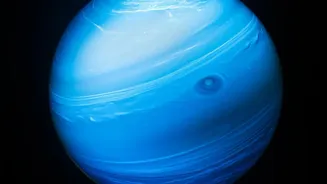
This gravitational tug-of-war can be described by a concept called the 'Hill sphere'. This is the region around a celestial body where its own gravity is the dominant force for attracting satellites. For a moon to stay in a stable orbit, it must remain comfortably inside its planet's Hill sphere. Because Mercury is both small (low mass) and very close to the Sun (a much larger mass), its Hill sphere is incredibly small. Any object that might have been a candidate to become Mercury's moon would likely have strayed outside this tiny zone of influence, at which point the Sun's gravity would have taken over. In contrast, a distant giant like Neptune has an enormous Hill sphere, allowing it to hold onto moons in extremely distant and long orbits.
Too Small to Capture and Hold
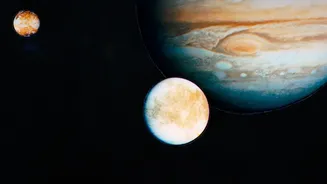
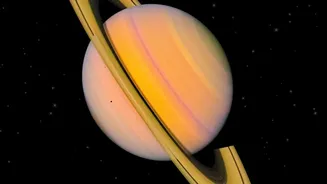
Mercury is the smallest planet in the solar system; it's even smaller than Jupiter's moon Ganymede and Saturn's moon Titan. Its small size and mass mean it has a relatively weak gravitational field of its own. While the giant planets like Jupiter and Saturn were able to form their own 'mini solar systems' of moons from leftover material, and Mars was able to capture a couple of asteroids, Mercury lacked the gravitational strength to do the same. Even if a passing asteroid or piece of debris ventured close enough, Mercury would have struggled to pull it into a stable orbit, especially with the Sun's constant interference.
A Violent and Empty Neighborhood
The formation of the inner solar system was a violent process. During a period known as the Late Heavy Bombardment, planets were pummeled by asteroids and comets. Any moon that might have tried to form around Mercury during this chaotic era would have stood little chance of survival. Furthermore, the intense solar winds from the young Sun would have stripped away much of the gas and dust in the area, leaving very little raw material for a moon to form in the first place. The region around Mercury was simply too hostile and sparse for a satellite to be born and raised successfully.
Not the Only Lonely Planet
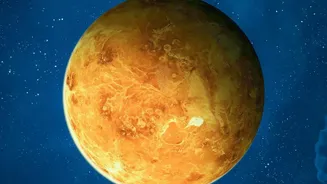
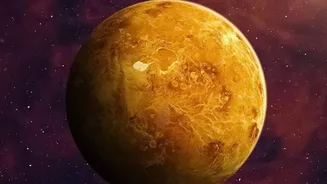
It is worth noting that Mercury is not entirely unique in its solitude. Its neighbour, Venus, also has no moons. While Venus is larger and has a stronger gravitational pull, scientists believe it may have had a moon in the distant past that was destroyed. One theory suggests that a massive impact created a moon, but that Venus's slow, backward rotation caused the moon's orbit to decay over time, eventually sending it crashing back into the planet. For both inner planets, their proximity to the Sun and their unique histories have left them without the natural satellites that are so common further out in the solar system.