


The Expected Grand Finale
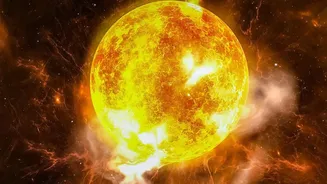
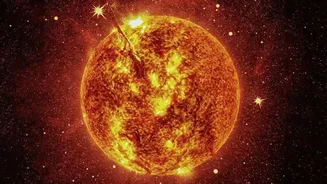
For most massive stars, those many times the size of our own sun, the end of life is a spectacular and violent event. After millions of years of fusing lighter elements into heavier ones, the star's core becomes a dense ball of iron. At this point, the nuclear
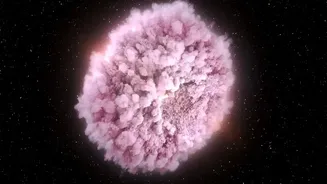
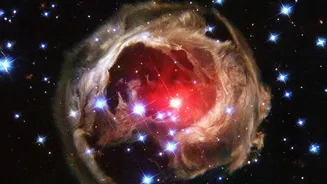
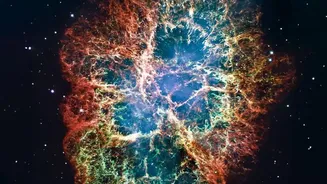
furnace shuts down. With the outward pressure from fusion gone, gravity wins in a catastrophic instant. The core collapses, and the star’s outer layers rebound off this incredibly dense new object—a neutron star—triggering a titanic explosion known as a core-collapse supernova. This blast seeds the cosmos with heavy elements like the oxygen we breathe and the calcium in our bones. For decades, this was the accepted story for how all big stars meet their end.
The Case of the Missing Explosion
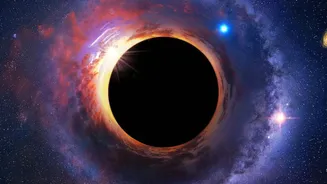
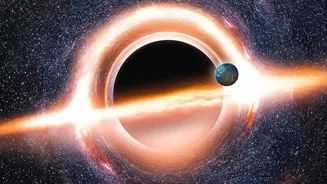
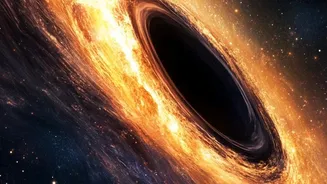
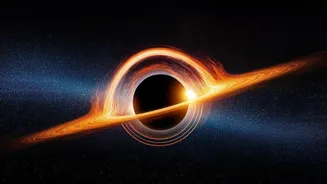
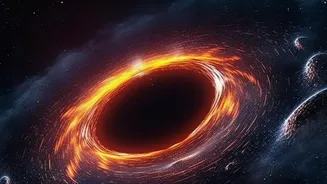
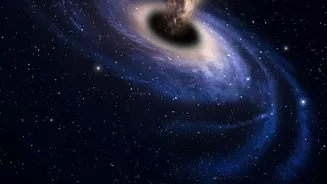
Astronomers, however, have long theorized about a different, quieter end for the most massive stars. Instead of a brilliant supernova, what if the core collapse is so overwhelming that nothing can escape? In this scenario, called a 'failed supernova,' the rebound shockwave that should tear the star apart never gets going. The star’s core continues to collapse past the neutron star stage, forming a black hole so powerful that it swallows the rest of the in-falling star, explosion and all. From our perspective on Earth, a bright star that was once visible in a galaxy would simply fade away, leaving nothing behind but a newly born black hole. Recent observations have provided compelling evidence of these disappearing acts, confirming that at least some stars die with a whimper, not a bang.
A Clue from Ghost Particles
So, what determines whether a star explodes or fizzles? The answer may lie with one of the universe's most elusive particles: the neutrino. These 'ghost particles' are produced in almost unimaginable numbers during a star's core collapse—trillions pass through your body every second, completely unnoticed. They carry away about 99% of the energy from the collapse. In a successful supernova, it's a tiny fraction of these neutrinos slamming into the material behind the shockwave that provides the extra push needed for a full-blown explosion. But recent studies suggest the process is more complex. Neutrinos come in different types, or 'flavors,' and they can switch between them. This flavor-changing behavior, previously thought to be a minor detail, might be the critical factor that decides if enough energy is deposited to trigger an explosion or if the neutrinos escape too efficiently, dooming the star to direct collapse.
The Challenge of Realistic Models
Proving this theory is where things get complicated. For decades, scientists have relied on computer simulations to model the chaotic interior of a dying star. Most of these models have been two-dimensional, essentially treating the star as a flat, symmetrical object. This makes the calculations manageable, but it's not realistic. Real stars are three-dimensional, turbulent, and messy. Running a full 3D simulation of a supernova is one of the most computationally demanding tasks in astrophysics, requiring millions of hours on the world's most powerful supercomputers. Early 3D models are already showing that the turbulence and asymmetries present in a real star, which are ignored in 2D, play a crucial role and can make explosions more likely. However, these models are still in their infancy and struggle to run for the full duration of an explosion while accurately accounting for all the complex physics, including the subtle behavior of neutrinos.