


The Mystery of a Moonless Twin
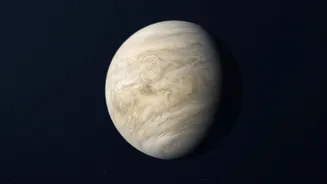
For centuries, astronomers have puzzled over Venus. It's similar to Earth in size, mass, and structure, leading to its nickname as our planetary twin. Yet, it spins incredibly slowly—one Venusian day lasts 243 Earth days—and in the opposite direction
of most other planets. And while Earth has a large, stable moon and even Mars has two small ones, Venus travels the solar system alone. This has long been a cosmic mystery. Previous theories suggested either Venus never had a moon to begin with, or that a moon it did have was destroyed by a massive impact from another object billions of years ago. But recent research offers a third, more intimate possibility: that Venus itself is responsible for its solitude.
A Tale of Two Tides
The key to the new theory lies in tidal forces, the same gravitational interaction that governs Earth and its moon. Earth rotates relatively quickly, once every 24 hours. This fast spin transfers rotational energy to our moon, causing it to slowly drift farther away from us by about four centimetres each year. New simulations from researchers at the University of California, Riverside, explored what would happen in the opposite scenario. Venus’s extremely slow rotation would have an inverse effect. Instead of pushing a moon away, the planet’s gravity would relentlessly pull it inward. The simulations suggest that a hypothetical Venusian moon wouldn’t have stood a chance; it would have been doomed to spiral closer and closer until it met a cataclysmic end.
The Simulation's Story: A Doomed Satellite
Researchers ran numerous computer models, testing how moons of different sizes would fare around a slowly rotating Venus. In nearly every scenario, the outcome was the same: the moon crashed into the planet. The models indicated that the larger the moon, the faster its demise. According to the study, a hypothetical moon could have survived for a period ranging from a few tens of millions of years to perhaps 1.7 billion years before it was pulled past the point of no return. At that point, the planet’s immense gravity would have torn the moon apart, with its debris raining down and ultimately being absorbed by Venus. This presents a compelling narrative: Venus didn't need an external catastrophe to become moonless; its own fundamental properties may have made it a 'moon-eater'.
The Search for a Smoking Gun
While the simulation is compelling, it is crucial to remember that it only shows what could happen, not what did happen. As the headline suggests, the evidence simply isn't there to confirm this dramatic event. Finding a 'smoking gun' on Venus is exceptionally difficult. A moon-sized object crashing into a planet would leave an enormous impact crater and scatter debris across the surface. However, Venus underwent a massive, planet-wide volcanic resurfacing event an estimated one billion years ago, which would have erased almost all evidence of such an ancient collision. What's more, the planet's crushingly dense and corrosive atmosphere would make quick work of any remaining surface clues. The proof, if it exists, may be hidden deep within the planet's mantle, potentially detectable only by future seismic missions.
An Enduring Cosmic Question
This moon-swallowing hypothesis is not the only explanation for Venus's strange characteristics. Other long-standing theories propose that a colossal impact with another large body in the early solar system could have reversed and slowed its spin. Another idea suggests that its thick, heavy atmosphere, dragging on the surface for billions of years, could have acted as a brake, gradually slowing its rotation to its current sluggish pace. Ultimately, the new simulations provide a fascinating, physically plausible mechanism for how Venus could have lost a moon. However, without direct observational evidence, it remains a captivating theory rather than a confirmed history. The mystery of why Earth's twin turned out so differently remains one of the most intriguing puzzles in our solar system.