

The Cosmic Ghosts in Question
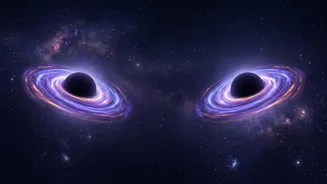
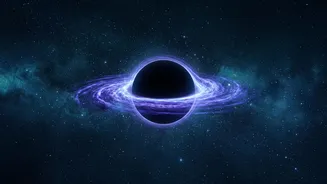
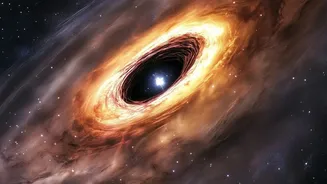
The study centres on what are known as primordial black holes, or PBHs. Unlike their more famous cousins, which form from the collapse of massive stars, PBHs are thought to be ancient relics born within the first second after the Big Bang. In that chaotic,
early moment, before stars or galaxies even existed, some theories suggest that incredibly dense pockets of matter could have collapsed under their own gravity to create black holes. These would not be the supermassive giants we see at the centres of galaxies, but could range from the mass of an asteroid to much larger sizes, scattered throughout the cosmos. Because they formed before stars, they are not bound by the same size constraints, making them a truly different class of object.
Why Have They Remained Hidden?
If the universe is potentially sprinkled with these ancient black holes, why have we not found them? The simple answer is that they are incredibly difficult to detect. A black hole floating quietly in space is, by its very nature, invisible. Scientists have to look for their gravitational effects on things around them, such as the bending of light from a distant star, a phenomenon known as gravitational lensing. Over the years, various observations have placed tight limits on how many PBHs could exist across different mass ranges. The lack of a definitive signal has led many to be sceptical, but the theory has persisted because of its tantalising potential to solve a much bigger problem.
The Dark Matter Connection
The main reason scientists are so interested in PBHs is that they are a compelling candidate for dark matter. We know that about 85% of the matter in the universe is 'dark'—it doesn't emit or reflect light, but we can detect its gravitational pull holding galaxies together. For decades, physicists have searched for a new, undiscovered particle to explain it. But what if dark matter is not a new particle at all? What if it's just a vast population of ancient, unseen black holes? This idea, first seriously proposed by Stephen Hawking, suggests that PBHs, being massive, stable, and non-interactive with light, fit the description of dark matter perfectly.
What 'Not Ruling Them Out' Really Means
Recent studies have revisited this cosmic puzzle. For example, some analyses of gravitational waves or the cosmic microwave background (the faint afterglow of the Big Bang) have been used to test the PBH hypothesis. A study might conclude, for instance, that 'stupendously large' black holes cannot make up all of dark matter, but it keeps the possibility open for smaller ones. This is the essence of scientific progress. 'Not ruling out' an idea means that within the limits of the data collected, the hypothesis remains viable. A recent study, for instance, showed that some supernovae we observe could actually be triggered by a PBH passing through a white dwarf star, providing an indirect clue to their existence. These findings do not prove PBHs exist, but they keep the theory in play, refining where we should look next and what kind of signals we might expect.
The Search Continues
The hunt for primordial black holes pushes the boundaries of astronomy and physics. Observatories like LIGO, which detects gravitational waves from colliding black holes, could potentially spot a merger involving a PBH, which might have a mass too small to have been formed by a star. Other research explores how PBHs might evaporate over trillions of years through Hawking radiation, producing a faint glow of particles that future telescopes might detect. Each new study, whether it constrains the possibilities or opens a new window of investigation, is a crucial step. It is a process of elimination and refinement, slowly peeling back the layers of the cosmos to understand its deepest secrets.