

Our Familiar Planetary Shield
Earth’s magnetosphere is our planet's first line of defense. Generated by the churning of our liquid iron outer core, it creates an invisible magnetic bubble that deflects the solar wind—a constant stream of charged particles from the Sun. This field
is tilted by about 11 degrees relative to our planet’s rotational axis, which is why your compass points to a magnetic north, not the true geographic North Pole. This tilt is a key feature, believed to be a natural result of the chaotic fluid motions that generate the field through a process known as the dynamo effect. For years, scientists assumed that other planets with magnetic fields, while varying in strength, would operate on broadly similar principles. Saturn, however, had other ideas.
Saturn’s Puzzling Perfection
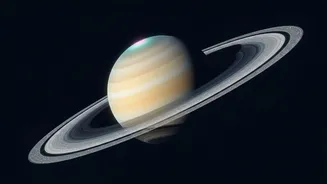
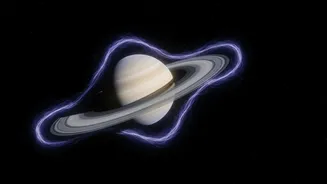
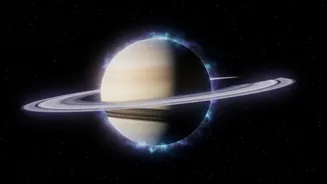
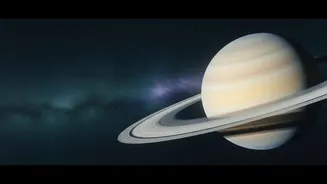
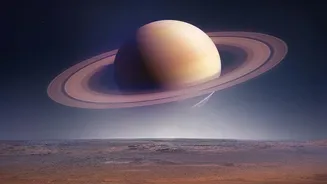
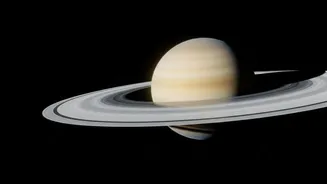
One of the most profound mysteries about Saturn is its magnetic field’s near-perfect alignment. While Earth's field is tilted, data from Cassini’s final orbits confirmed that Saturn’s magnetic axis is off by less than 0.01 degrees from its spin axis. This extraordinary symmetry is a major headache for dynamo theory. According to established principles, a perfectly aligned magnetic field should not be sustainable; it should decay. The fact that Saturn’s exists at all suggests something strange is happening deep within the gas giant. Scientists now theorize that a thick, stable layer of metallic hydrogen might exist above the main dynamo region, effectively filtering out any non-symmetrical components of the field before they reach the planet's surface. This makes Saturn's field appear deceptively simple on the outside, hiding a complex interior.
A Shield Dragged and Distorted
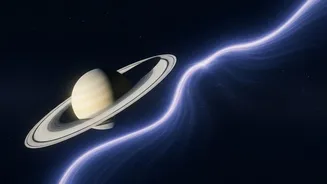
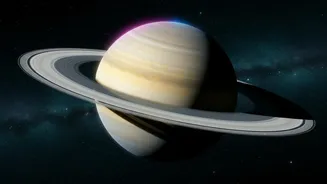
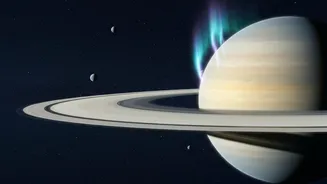
The differences don't stop at the tilt. Recent analysis shows Saturn's magnetosphere is also oddly shaped. On Earth, the point where the magnetic field funnels particles toward the pole—the magnetic cusp—is centered around noon, facing the Sun. But on Saturn, this cusp is consistently dragged toward the afternoon side, sometimes as far as 3 o'clock on a clock face. This distortion isn't caused by the Sun, but by Saturn itself. The planet’s incredibly fast rotation (a day is just under 11 hours) combines with a heavy soup of plasma spewed into space by its moon Enceladus. This material, originating from geysers of water vapor on the icy moon, gets ionized and pulled around by Saturn’s rapid spin, effectively overpowering the solar wind and twisting the entire magnetic bubble out of shape.
Cassini’s Grand Finale Revelations
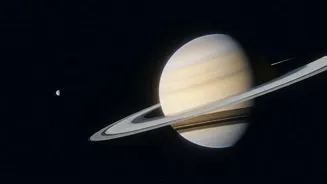
Much of this new understanding was made possible by Cassini’s daring final act. In 2017, after 13 years of orbiting the ringed planet, the spacecraft performed a series of 22 dives through the unexplored gap between Saturn and its innermost rings. This “Grand Finale” allowed instruments to directly sample the environment in unprecedented detail. It was during these passes that scientists confirmed the near-perfect magnetic alignment and measured the strange influx of material from the rings into the planet's atmosphere. These risky maneuvers provided a treasure trove of data that scientists are still analyzing today, rewriting our understanding of how giant planet systems work. The mission may be over, but its legacy of discovery continues to unfold.
Why This Cosmic Oddity Matters
Saturn’s unique magnetosphere forces a rethink of our universal theories about planets. It shows that there isn’t a single model for how a magnetic shield is generated and shaped. The powerful influence of Saturn’s own rotation and its active moons like Enceladus proves that for giant planets, internal dynamics can be more important than the external pressure from the Sun. This has huge implications for studying exoplanets. When we detect magnetic fields around distant worlds, we can no longer assume they will be Earth-like. Saturn provides a crucial example of an entirely different kind of magnetic environment, one shaped by a complex interplay of planetary spin, moons, and rings. Understanding this system helps us appreciate the vast diversity of worlds that exist in our galaxy.