



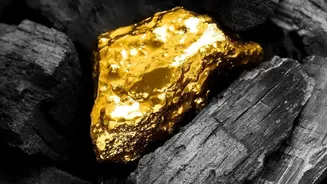
An Element of Distinction
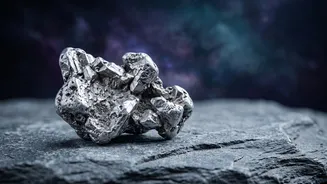
On Earth, platinum is a symbol of rarity and endurance. It is thirty times rarer than gold, with a high melting point and resistance to corrosion that makes it invaluable not just for jewellery, but also in medicine and high-tech electronics. We mine
it from deep within the Earth's crust, but its journey didn't begin here. To find its true birthplace, we must look to the stars. The platinum we hold in our hands is an ancient traveller, an alien element forged in an environment far more extreme than any on Earth. Its presence on our planet is the final chapter of a story that spans billions of years and unimaginable distances.
Forged in Cosmic Fire
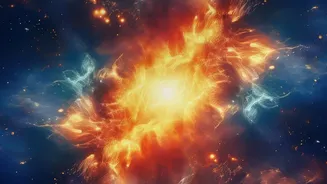
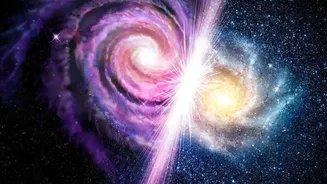
Most elements lighter than iron are created in the cores of stars through nuclear fusion. But creating heavy elements like platinum requires a different, far more violent process. For decades, scientists debated the primary source, with supernovae being a leading candidate. However, evidence now strongly points to a more spectacular event: the collision of two neutron stars. Neutron stars are the incredibly dense collapsed cores of massive stars that have already died. When two of these stellar remnants, locked in a gravitational dance, finally spiral into each other, they merge in a cataclysmic explosion known as a kilonova. This collision creates the extreme conditions necessary for the rapid neutron-capture process, or "r-process," to occur. In the chaotic seconds of the merger, atomic nuclei are bombarded with a dense flood of neutrons, rapidly building them up into the heaviest elements, including hundreds of Earth-masses worth of gold and platinum.
A Journey Through the Void
The force of the kilonova explosion is so immense that it flings this newly created treasure trove of heavy elements out into the cosmos at incredible speeds. This material, now a hot, expanding cloud of debris, travels across the vast distances of interstellar space. As it journeys, it cools and disperses, mingling with the vast clouds of gas and dust that drift between stars. These tiny particles of platinum, gold, and other heavy elements become what is known as interstellar dust. For millions or even billions of years, these precious atoms drift through the galaxy, waiting for gravity to call them to their next destination. They are the seeds of future worlds, scattered far and wide from their violent birthplace.
The Seeds of a New World
Gravity is the great sculptor of the cosmos. Over time, it pulls these enriched clouds of gas and interstellar dust together. As the cloud collapses, it begins to rotate, flattening into a disc with a new star igniting at its centre. This was the story of our own solar system, born from such a cloud some 4.6 billion years ago. The interstellar dust, carrying its cargo of platinum from long-dead stars, became the raw material for everything that would form within this new system. The tiny dust grains stuck together, a process known as accretion, forming larger and larger clumps. These clumps grew from pebbles to rocks, from planetesimals to the planets, moons, and asteroids we see today.
An Earthly Inheritance
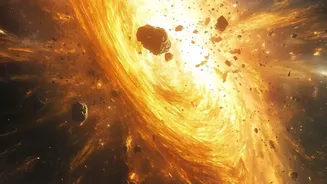
The early Earth was a molten ball, and heavy elements like platinum and iron, being dense, should have sunk deep into the planet's core, lost to us forever. The reason we can find platinum near the surface today is likely due to a period of intense bombardment late in Earth's formation. Asteroids and moon-sized bodies, themselves formed from the same heavy-element-rich dust cloud, crashed into our young planet. These impacts delivered a new supply of platinum and other precious metals, which became trapped in the upper mantle rather than sinking to the core. Over billions of years, geological processes like convection have churned this material, bringing it up into the crust where it becomes accessible to us.