





From Test Flight to Operational Mission
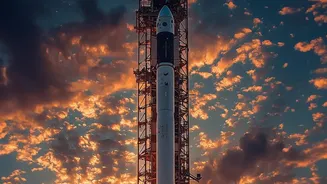
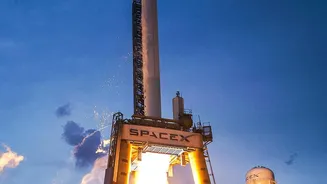
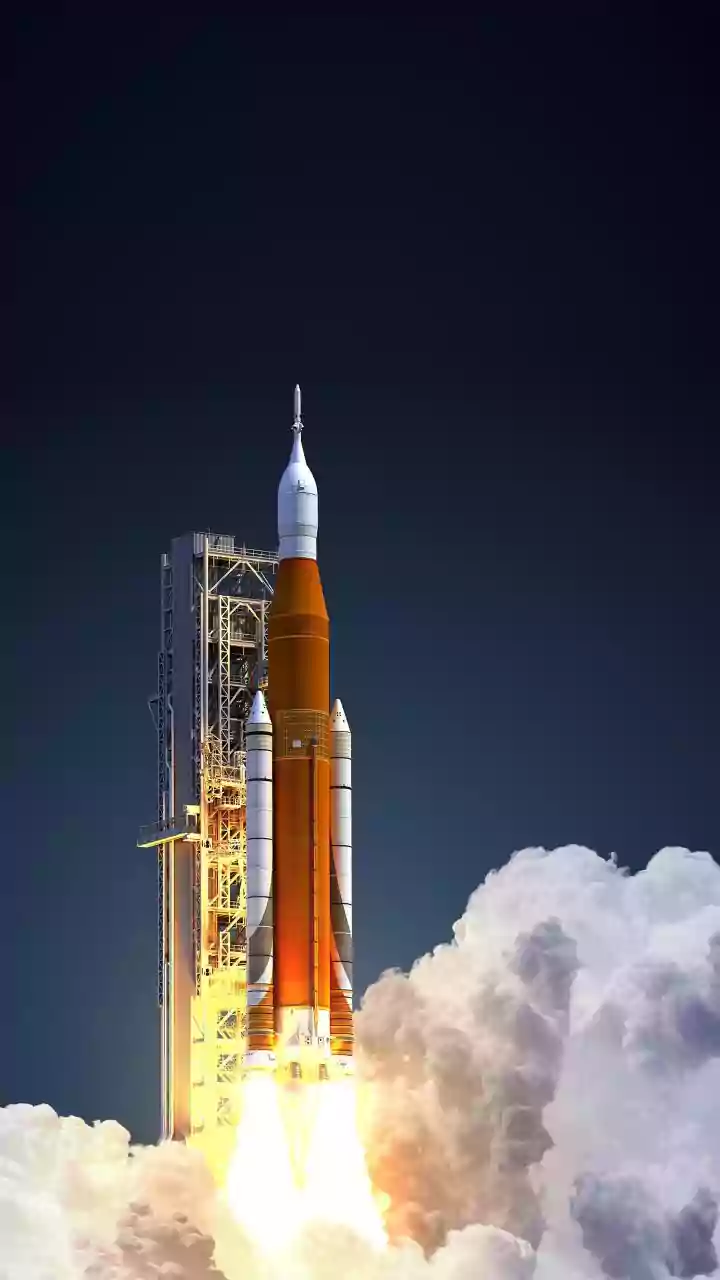
On September 28, 2026, SpaceX's Starship, the largest and most powerful rocket ever built, lifted off from its Starbase facility in Texas. While previous flights tested ascent, reentry, and maneuvering, this mission, known as Flight 14, had a clear commercial
goal: deliver a payload to a working orbit. After some in-flight drama, including the early shutdown of one engine, the flight controllers made the call to proceed with an orbital insertion burn. This decision marked a pivotal moment, pushing Starship into a sustained orbit around Earth for the first time. The primary objective was then to release 26 next-generation Starlink satellites, a task it completed flawlessly, confirming the vehicle’s long-theorized capability as a payload delivery system. The successful deployment represents a monumental step, graduating Starship from an experimental project to a functional part of SpaceX's business strategy.
The 'Pez Dispenser' at Work
The deployment itself was a unique mechanical feat. Instead of a traditional clamshell fairing that splits open, Starship uses a narrow slot-like door from which satellites are pushed out, a method lovingly nicknamed the “Pez dispenser” by SpaceX CEO Elon Musk. This design is tailored for Starlink satellites, which are stacked internally like the rectangular candies. For about 30 minutes, cameras tracked as the 26 satellites were smoothly ejected one by one into low Earth orbit. SpaceX quickly confirmed that it had established contact with all the deployed satellites, which were then instructed to unfold their solar arrays and use their own thrusters to climb to their operational altitude. They are expected to begin serving customers within weeks, directly adding to the capacity of the massive satellite internet constellation.
Why V3 Starlinks Need Starship
This mission was not just a test for Starship, but a necessity for Starlink. The deployed satellites were the new 'V3' models, which are significantly larger and more capable than their predecessors. Each V3 satellite weighs around 2,000 kilograms, about twice as much as the previous V2 version, and is too big and heavy to be launched on SpaceX's reliable Falcon 9 rocket. This makes Starship the only vehicle capable of deploying the next generation of the Starlink network. The V3 satellites promise a massive leap in performance, with each one providing roughly 10 times the downlink capacity of a V2 satellite. A single Starship launching a partial load of 26 V3 satellites adds about as much capacity to the network as 10 Falcon 9 launches carrying the older V2 models. When fully loaded, Starship can carry up to 60 V3 satellites, representing a 20-fold increase in capacity deployment compared to a Falcon 9 flight.
A Game-Changer for SpaceX
Successfully deploying operational satellites fundamentally changes the narrative around Starship. It is no longer just a vehicle for ambitious future goals like missions to Mars; it is now the core engine for scaling SpaceX's most profitable commercial venture. The ability to rapidly deploy larger, more powerful V3 satellites will allow Starlink to significantly boost network capacity, increase speeds, and handle more users, especially in densely populated areas where the service has faced congestion. This operational success also serves as a powerful demonstration for other potential customers. Having proven its ability to deliver a payload to orbit, SpaceX can now more concretely market Starship for a wide range of missions, including launching large government satellites, deploying future orbital infrastructure, and supporting NASA's Artemis program to return astronauts to the Moon.