





A Panoramic Universe
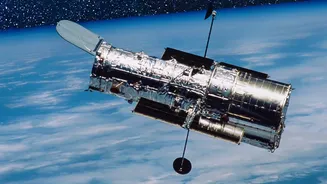
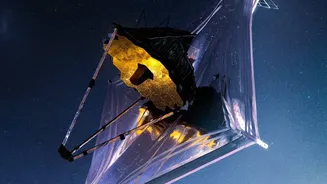
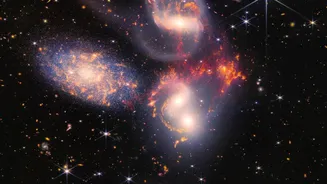
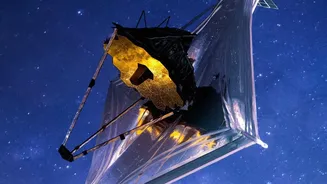
While the Hubble and James Webb Space Telescopes provide stunningly deep, high-resolution close-ups of small patches of the sky, Roman is built for breadth. Its primary mirror is the same size as Hubble's, ensuring similar sharpness, but its Wide Field
Instrument (WFI) is a game-changer. This 300-megapixel camera gives Roman a field of view at least 100 times larger than Hubble's infrared camera. Imagine trying to create a mosaic of a massive landscape by taking thousands of individual photos. Hubble and Webb are capturing the exquisite detail of single tiles, while Roman will photograph huge sections of the mosaic all at once. This capability will allow it to map vast regions of the cosmos with unprecedented speed, doing in months what would take Hubble centuries.
Hunting the Universe's Biggest Mysteries
Roman’s main purpose is to tackle two of the most profound questions in cosmology: dark energy and dark matter. These invisible components are believed to make up about 95% of the universe, but their nature remains a puzzle. Roman will investigate dark energy—the mysterious force causing the universe's expansion to accelerate—using three distinct methods. It will survey thousands of distant exploding stars called Type Ia supernovae, map the large-scale structure of galaxies by observing Baryonic Acoustic Oscillations, and study how the light from millions of galaxies is subtly distorted by gravity, a phenomenon known as weak gravitational lensing. By cross-referencing data from these three techniques, scientists hope to finally understand dark energy's influence on the cosmos.
A New Census of Alien Worlds
Beyond cosmology, Roman is set to become a prolific exoplanet hunter. Its wide, deep surveys will employ a powerful technique called gravitational microlensing. This method watches for the temporary brightening of a distant star, which occurs when a closer star and its potential planets pass in front of it, with their gravity acting as a natural magnifying glass. This approach is sensitive to planets that are hard to find with other methods, including worlds with masses as low as Mars or even 'rogue' planets that don't orbit a star at all. In addition to discovering thousands of planets through microlensing, Roman's continuous monitoring of hundreds of millions of stars is expected to detect around 100,000 planets as they transit, or pass in front of, their host stars. This will create an enormous statistical database on planetary systems throughout our galaxy.
A Companion, Not a Replacement
Roman is not designed to replace Hubble or Webb, but to work in synergy with them. Think of Roman as the ultimate scout. Its vast surveys will identify countless objects and phenomena of interest—unusual galaxies, explosive events, and intriguing planetary systems. Astronomers can then use the powerful 'zoom lenses' of Hubble and Webb to perform detailed follow-up observations on the most compelling targets Roman discovers. This complementary approach will maximize the scientific return from all three great observatories, giving humanity a more complete picture of the cosmos than ever before. Roman also carries a technology demonstrator, the Coronagraph Instrument, which will test new methods for directly imaging planets by blocking out the overwhelming glare of their host stars, paving the way for future missions.