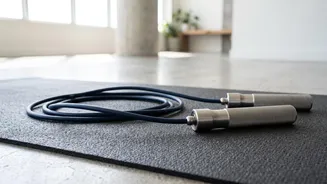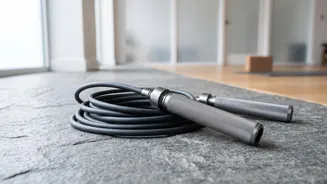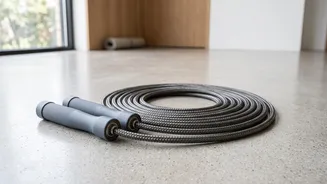





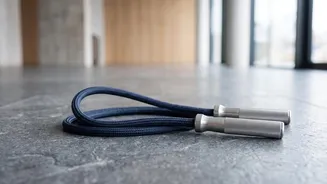


In the world of cardio, running and jumping rope are two undisputed heavyweights. Both promise a great workout, but they deliver it in very different ways. Let's break down how they stack up on intensity, coordination, and overall fitness benefits.
Intensity and Calorie Burn
When
it comes to burning calories efficiently, jumping rope often has a slight edge. At a moderate to high intensity, jumping rope can burn between 10 to 16 calories per minute, a rate comparable to or even greater than running at a vigorous pace. Studies have shown that just 10 minutes of jumping rope can provide similar cardiovascular benefits to 30 minutes of jogging. The reason for this high-intensity output is that jumping rope is a full-body workout. It engages your calves, quads, and core, but also requires constant work from your shoulders, arms, and back to control the rope, especially if you use a weighted one. Running primarily works the lower body and core, but with less upper-body engagement.
The Coordination Factor
This is where jumping rope truly shines. The activity is a masterclass in coordination, demanding constant communication between your brain and body. You must synchronise the rotation of your wrists with the timing of your jumps, all while maintaining a steady rhythm. This process sharpens hand-eye coordination, balance, and agility. Athletes, especially boxers and those in court sports, use jump ropes specifically to improve their footwork, rhythm, and reactive speed. Running, while requiring a degree of coordination to maintain form and balance, is a more natural and less technically demanding movement for most people. While running improves coordination, jump rope actively trains it by forcing your upper and lower body to work together in precise, timed movements.
Impact on Your Joints
One of the most significant differences lies in the impact on your joints. Running is a high-impact activity, with forces travelling up from your feet to your knees and hips with every stride on hard pavement. This repetitive stress is a common cause of overuse injuries. When performed correctly, jumping rope is a lower-impact exercise. The proper form involves staying on the balls of your feet and making small, controlled bounces, which allows your leg muscles to act as natural shock absorbers. This can make it a safer option for people with sensitive joints or a suitable cross-training activity for runners on their off-days to build ankle stability and prevent injuries like shin splints.
Muscle Engagement and Accessibility
Both exercises are fantastic for the lower body, targeting calves, quads, hamstrings, and glutes. However, running tends to engage the glutes and hamstrings through a greater range of motion, while jumping rope heavily recruits the calf muscles and also provides a significant upper-body workout for the shoulders, back, and arms. In terms of accessibility, both are low-cost. Running requires only a good pair of shoes and can be done almost anywhere outdoors. However, it is weather-dependent. A jump rope is highly portable and can be used in a very small space, making it an excellent option for indoor workouts regardless of the weather.
Which One Is Right for You?
Choosing between jumping rope and running depends entirely on your personal fitness goals. If your primary goal is to improve coordination, agility, and get a high intensity , full body workout in a short amount of time , jumping rope is an outstanding choice . Its skill based nature keeps workouts engaging and challenging . If you 're focused on building long distance endurance and prefer a simpler , more meditative form of exercise that allows you to explore the outdoors , running is an excellent path . Many people find a hybrid approach to be the most effective . Using a jump rope as a warm up or on cross training days can enhance a runner 's performance by improving foot speed and strengthening lower leg muscles , making them more resilient to injury .