






Antarctica's Faltering Giant
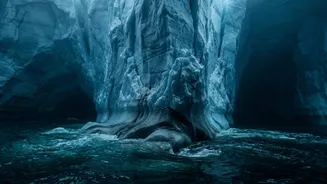
Covering an area roughly the size of Florida or Senegal, the Thwaites Glacier is one of the largest and fastest-melting glaciers on Earth. For decades, scientists have watched with concern as it loses ice at an alarming rate, currently contributing to
about 4% of annual global sea-level rise. But its importance goes far beyond its own mass. Thwaites acts like a giant cork, holding back the rest of the vast West Antarctic Ice Sheet. If it were to collapse completely, it could trigger a wider destabilisation that would ultimately lead to around 10 feet of sea-level rise, a catastrophic scenario for coastal communities worldwide. This outsized impact is what earned it the ominous nickname, first popularised in a 2017 magazine article.
Solving a Decades-Old Puzzle
Scientists have long known that the glacier was retreating, losing more than a trillion tons of ice since 2000. The primary suspect has always been the warming ocean. However, the exact mechanisms were poorly understood, making it difficult to predict how quickly the disaster scenario could unfold. Previous models often struggled to account for the speed of the melt. This left a crucial gap in our understanding: what was happening in the hidden world where the glacier meets the sea?
The Ocean's Hidden Attack
A recent study published in the journal Nature Communications provides a critical breakthrough. Researchers from the University of California, Irvine, and NASA's Jet Propulsion Laboratory have found that warm ocean water is infiltrating deep beneath the glacier in a more aggressive way than previously accounted for. This process is focused on the 'grounding zone', the area where the glacier lifts off the seabed and begins to float. Earlier models treated this as a simple line, but the new research shows it's a zone several kilometres wide where tides act like a pump. As the tide rises and falls, it pushes relatively warm, salty ocean water far underneath the ice, causing 'vigorous melting' from below.
A Doubling of Projections
By incorporating this new understanding of tidal pumping into their models, the scientists came to a startling conclusion. Even with no further global warming, Thwaites' contribution to sea-level rise by the year 2100 could be up to 1.2 inches (30 millimeters)—double what previous estimates suggested. Furthermore, the study found there is a 60% chance that the glacier will become unpinned from a crucial underwater ridge that is currently holding it back. This could happen as early as the late 2030s and would likely cause the glacier's retreat to accelerate dramatically.
Why It Matters for India's Coastline
While Antarctica may seem a world away, the fate of the Thwaites Glacier has direct consequences for India. With a long and densely populated coastline, India is highly vulnerable to sea-level rise. Major cities like Mumbai, Kolkata, and Chennai are already facing increased risks of flooding. The collapse of Thwaites alone would add 65 centimeters (about two feet) to global sea levels, inundating low-lying areas, threatening critical infrastructure like ports and power plants, and forcing the displacement of millions of people. It would also worsen coastal erosion, which has already claimed hundreds of square kilometres of Indian land, and increase saltwater intrusion into freshwater sources, jeopardizing agriculture and drinking water for coastal communities.