



The Workhorse: GSLV-F17
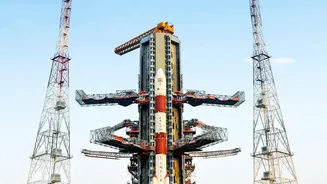
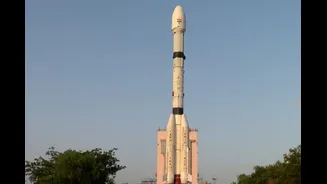
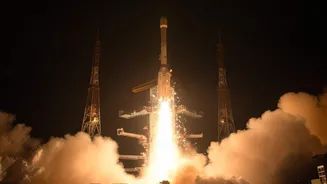
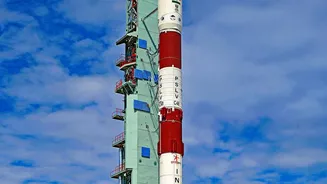
The star of the launch was the Geosynchronous Satellite Launch Vehicle (GSLV), a powerful three-stage rocket operated by the Indian Space Research Organisation (ISRO). Standing 51.7 metres tall, the GSLV is designed to lift heavy satellites into high-energy
orbits. The GSLV-F17 mission was its 19th flight. The rocket's first stage uses a solid propellant motor augmented by four liquid-fueled strap-on boosters. Its crucial third stage is a homegrown cryogenic engine, which uses super-cooled liquid hydrogen and liquid oxygen as propellants. This cryogenic technology gives the GSLV the immense power needed to place satellites weighing over two tonnes into Geosynchronous Transfer Orbit (GTO), an orbit roughly 36,000 km above Earth. The successful flight reinforces confidence in the GSLV as ISRO’s reliable vehicle for launching heavy communication and observation satellites.
India’s New Eye in a Geo-Orbit
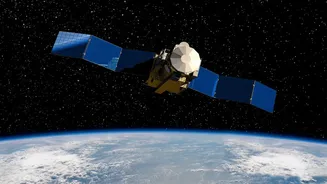
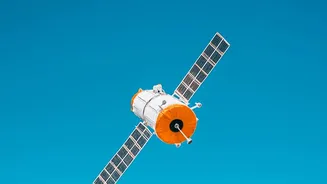
The passenger on this flight, EOS-05, is no ordinary satellite. It is India’s first dedicated imaging satellite designed to operate from a geosynchronous orbit. While most earth observation satellites like those in the Cartosat or RISAT series are in Low Earth Orbit (LEO) and pass over a location periodically, a satellite in a geo-orbit moves at the same speed as the Earth's rotation. This allows EOS-05 to remain over the same broad region, providing near-continuous observation of the Indian subcontinent. Weighing 2,367 kg, EOS-05 is the heaviest payload ever launched by a GSLV, a testament to the rocket's improved capability. The satellite carries advanced multispectral imagers that can provide high-resolution pictures for various applications.
A Textbook Launch from Sriharikota
The mission unfolded precisely as planned from the Satish Dhawan Space Centre in Sriharikota. Lifting off at 2:55 AM on September 4, the GSLV-F17 performed perfectly through its three stages. Roughly 18 minutes after liftoff, the rocket successfully injected the EOS-05 satellite into its intended sub-geosynchronous transfer orbit. Soon after separation, ISRO's ground stations confirmed that the satellite's solar panels had deployed and its health parameters were normal. In the coming days, ISRO scientists will perform a series of intricate orbit-raising manoeuvres to position the satellite in its final circular geosynchronous orbit. This success was a significant moment for the agency, marking its first successful launch of 2026 after some earlier setbacks.
Why This Mission Matters
The EOS-05 mission is a game-changer for India's remote sensing capabilities. Its ability to provide near real-time imagery has wide-ranging benefits. For civilians, it means enhanced monitoring of natural disasters like cyclones, floods, and forest fires, as well as better data for agriculture, forestry, and environmental management. The data will help in everything from forecasting agricultural output to managing water resources and planning urban development. From a strategic standpoint, the satellite’s persistent watch over a large area significantly boosts the country’s surveillance capabilities, allowing for better monitoring of border regions and maritime zones. The mission not only places a powerful new tool in the sky but also demonstrates ISRO's mastery over complex launch technologies, bolstering India's position as a major space-faring nation.