







What's the New Breakthrough?
In late June 2026, researchers at Meta announced a significant leap forward with an AI system that translates brain activity into text without requiring surgery. The system, called Brain2Qwerty v2, achieved an average word accuracy rate of 61 percent,
with one participant reaching as high as 78 percent. This means that for the most successful user, more than half of the sentences decoded from their brainwaves had one word error or less. This is a dramatic improvement over previous non-invasive methods, which hovered around an 8 percent accuracy rate. Rather than just decoding single letters or words, the new model can reconstruct entire sentences from raw brain signals, marking a major step towards creating a practical communication aid.
How Does It Actually Work?
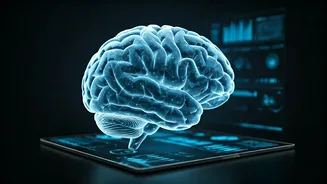
The technology sits at the intersection of neuroscience and artificial intelligence, in a field known as Brain-Computer Interfaces (BCIs). The process starts by measuring brain activity. Some methods use non-invasive caps fitted with sensors to record electrical (EEG) or magnetic (MEG) signals from the brain. These signals, which are incredibly complex and noisy, are then fed into a powerful AI. The secret ingredient in recent successes is the use of Large Language Models (LLMs), similar to the technology that powers popular chatbots. The AI is trained on vast amounts of data to find patterns, learning to map specific brain signals to the words and sentences a person intends to type or say. In essence, the AI acts as a sophisticated translator between the language of the brain and written language.
The Two Paths: Invasive vs. Non-Invasive
There are broadly two approaches to creating these interfaces. The first is invasive, which involves surgically placing implants, like micro-electrodes, directly onto the brain. Companies like Neuralink are pursuing this path, and it generally yields higher accuracy because the signals are clearer. However, it also carries significant risks, such as brain hemorrhage and infection, and the long-term stability of implants is still a challenge. The second path is non-invasive, using external devices like the MEG scanners used in Meta's research. This approach is much safer and easier to scale, but has historically struggled with decoding accuracy due to the noisy signals recorded through the skull. The recent breakthroughs in AI are closing this performance gap, making non-invasive methods a more viable long-term solution, though the required machinery, like MEG scanners, can be bulky and expensive.
More Than Tech: A Lifeline for Patients
The primary goal of this research is profoundly human: to restore the ability to communicate for people who have been silenced by paralysis from conditions like amyotrophic lateral sclerosis (ALS), stroke, or brain injuries. For individuals in a 'locked-in' state—fully conscious but unable to move or speak—a functional BCI could be life-changing. It could allow them to talk with loved ones, control smart home devices, and even return to work. Researchers have already demonstrated systems that allow paralysed individuals to type on a computer or control a prosthetic limb using their thoughts. The latest AI-powered decoders that produce full sentences at a conversational pace represent the next frontier in restoring autonomy and connection for thousands of patients.
The 'Mind-Reading' Myth and Ethical Questions
The idea of a machine that can read our thoughts instantly brings up both excitement and fear. However, it's important to separate the science from the hype. Current systems are not reading abstract, private thoughts or memories. Instead, they are decoding the brain signals associated with the intention to produce speech or type specific words. Even so, the rapid progress is forcing a critical conversation about ethics. Questions around mental privacy, consent, and data security are paramount. Who should have access to this brain data? How can it be protected from misuse by corporations or governments? As this technology evolves from a clinical tool to a potential consumer product, establishing clear regulations and ethical guidelines will be just as crucial as the scientific breakthroughs themselves.