

Meet the Lion Nebula
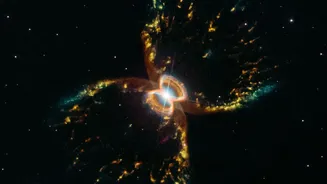
Located about 3,000 light-years from Earth, NGC 2392 has been nicknamed the Lion Nebula for its striking resemblance to a lion's head, complete with a flowing mane. This celestial marvel is not a place where stars are born, but rather a stunning monument
to a star's death. It belongs to a class of objects known as planetary nebulae, which, despite their name, have nothing to do with planets. The term is a historical holdover from the 18th century, when these faint, fuzzy objects looked like planets through early telescopes. We now know they are the ejected outer layers of a dying star, set aglow by the super-hot stellar core left behind. For years, telescopes like Hubble have studied the Lion Nebula, but Webb’s latest image gives us an unprecedented look inside its intricate form.
Webb’s Infrared Advantage
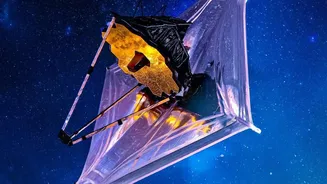
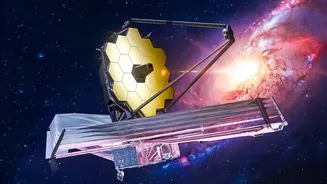
The James Webb Space Telescope is uniquely equipped to study objects like the Lion Nebula because it sees the universe in infrared light. While visible light, which our eyes and telescopes like Hubble see, is often blocked by gas and dust, infrared light can pass through these cosmic clouds more easily. By combining its Near-Infrared Camera (NIRCam) and Mid-Infrared Instrument (MIRI), Webb can peer into the heart of the nebula and distinguish features that were previously blurred or hidden. This allows astronomers to dissect the nebula's structure, revealing fine filaments and clumps of material that hold clues to how it was formed and how it continues to evolve. The new portrait is a composite of these different infrared views, creating a richer, more detailed picture than ever before.
Deconstructing the Lion's Mane
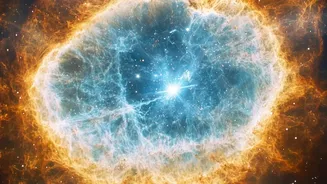
So, what exactly has Webb revealed? The new image sharpens our view of the nebula's key components. At the center sits the dying star, a white dwarf, so hot that its intense radiation is cooking the surrounding gas, causing it to glow. This creates a bubble of ionized gas that forms the lion's 'face'. Webb's view clearly shows cavernous shells and rings within this central bubble. The 'mane' is a spectacular, thicker ring of material farther out. Previous images showed hazy, comet-like objects here, but Webb clarifies these are dense clumps of dust and molecular hydrogen. Some of these clumps, seen in orange and yellow, have managed to survive the fierce radiation from the central star and are protecting the material trailing behind them, creating beautiful, tail-like structures.
A Snapshot of Cosmic Change
A planetary nebula is not a static object; it’s a dynamic, evolving environment. The structures we see are a snapshot in time, sculpted over thousands of years by powerful forces. The central star is blasting out stellar winds, and as this fast-moving material slams into slower-moving gas that was ejected earlier in the star's life, it creates the complex shapes we observe. By studying the precise location and composition of the filaments and clumps in the Lion Nebula, astronomers can better model how these stellar winds interact with the surrounding gas and dust. This helps them understand the final, chaotic stages of life for stars like our own Sun. The image confirms that the nebula is a temporary spectacle; astronomers estimate it will completely disperse into space in about 10,000 years—a blink of an eye in cosmic terms.