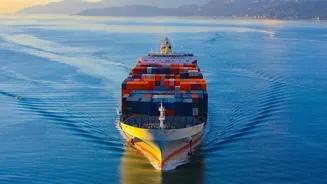






Two Arteries of Global Commerce
To understand the gravity of the situation, one must first appreciate the geography. The Strait of Hormuz, connecting the Persian Gulf to the open ocean, is the world's single most important oil transit chokepoint. The Bab el-Mandeb strait, which translates
to "Gate of Tears," is a narrow channel linking the Red Sea to the Indian Ocean. Together with the Suez Canal, it forms the main maritime corridor for trade between Asia and Europe. For a country like India, these are not distant waterways; they are vital economic lifelines. An estimated 80% of India's merchandise trade with Europe, including key exports like pharmaceuticals, textiles, and auto components, travels through the Bab el-Mandeb route. Any disruption here has a direct and immediate impact on the Indian economy.
The Deadly New Flashpoint
The "latest development" is a significant and tragic escalation. This week, Iran-backed Houthi rebels in Yemen launched a missile attack on a commercial vessel, the Tanzania-flagged Tihamah, in the Bab el-Mandeb strait. The strike resulted in the deaths of six people, including four crew members and two security personnel. This marks the first time recent Houthi attacks on shipping have caused fatalities, crossing a grim new threshold. The incident occurs against the backdrop of a wider regional conflict that has seen the Strait of Hormuz effectively disrupted for months, with Iran and the US in a tense standoff. With Hormuz already constricted, global shipping, especially Saudi Arabian oil, had increasingly diverted to the Red Sea route, making Bab el-Mandeb even more critical.
What This Means for India
For India, the implications are direct and concerning. First, it means higher costs for trade. The attack will inevitably cause war risk insurance premiums for vessels transiting the Red Sea to rise further. These costs are passed down the supply chain, making Indian exports to Europe more expensive and imports from the continent costlier. Second, it jeopardises energy security. India imports over 85% of its crude oil, and while not all of it transits Bab el-Mandeb, the strait is a key route for global supply. Disruption to the nearly 7.4 million barrels of oil passing through the strait daily tightens the global market, putting upward pressure on the prices that India pays. With both Hormuz and Bab el-Mandeb now high-risk zones, India faces a dual threat to its economic stability.
What This Does Not Mean (Yet)
It is crucial, however, to separate risk from reality. This development does not mean the Bab el-Mandeb strait is completely closed. Shipping continues, but under a cloud of heightened danger and at a greater expense. Unlike the near-total shutdown seen at times in Hormuz, this is an escalation of targeted attacks rather than a full-scale blockade. It does not mean a world war is imminent, but rather that a regional conflict is spilling over and impacting international commerce in a more direct and deadly way. The primary target appears to be vessels linked to Saudi Arabia or its allies in the ongoing Yemen conflict, but the risk of misidentification is high, putting all commercial shipping in peril. It also doesn't mean a guaranteed spike in petrol prices overnight, but it adds another layer of volatility to a global energy market that is already incredibly tense.
The Wider Geopolitical Chessboard
This attack cannot be viewed in isolation. It is a calculated move on a much larger geopolitical chessboard. With Iran's leverage over the Strait of Hormuz already established, the Houthi action in Bab el-Mandeb puts pressure on a second critical chokepoint simultaneously. This serves the interests of both the Houthis, who are engaged in their own conflict within Yemen, and their backer, Iran, which is locked in a broader confrontation with the United States and its regional allies like Saudi Arabia. By demonstrating the ability to disrupt trade in the Red Sea, the Houthis increase their own strategic importance while adding to the economic and security headaches for their adversaries. The incident is a stark reminder that regional conflicts can have far-reaching global consequences, turning commercial sea lanes into front lines.