

A Glimpse into the Early Universe
The light from galaxy J0148-4214 has travelled for over 12.5 billion years to reach us, offering a snapshot of what the cosmos looked like just 1.2 billion years after the Big Bang. Typically, astronomers expect to find a single supermassive black hole
at the heart of a mature galaxy. Finding evidence of three in such a young system is an unprecedented discovery, made possible by the powerful James Webb Space Telescope (JWST). An international team led by the Max Planck Institute for Extraterrestrial Physics used the JWST’s Near-Infrared Spectrograph to analyse the galaxy. They couldn't see the black holes directly, but instead measured the frantic motion of hydrogen gas swirling around them, a tell-tale sign of these cosmic giants feeding.
Seeing Triple in a Crowded Galaxy
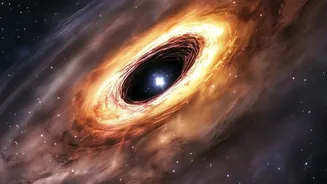
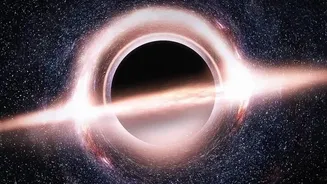
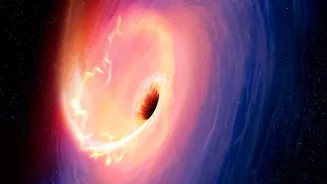
The data revealed three distinct regions of rapidly moving gas, each signalling an 'actively accreting' supermassive black hole—a black hole that is voraciously consuming surrounding material from a swirling accretion disk. Two of the black holes are located close together in the galactic centre, while a third is found further out, about 5,500 light-years from the central pair. The masses of these cosmic behemoths vary significantly, estimated at around 80 million, 2 million, and 600,000 times the mass of our sun. This finding is the first evidence of a black hole triplet in the distant universe, painting a picture of a galaxy in the middle of a chaotic series of mergers.
An Unprecedented Closeness
What makes this discovery truly remarkable is the proximity of the central pair. They are separated by a projected distance of just 190 parsecs, which is roughly 620 light-years. While that sounds vast in human terms, it's an incredibly small separation for two supermassive black holes. Detecting two distinct objects this close together at such an enormous distance is a major technical achievement. This close-knit pair is expected to be on a collision course, predicted to merge within the next few hundred million years—a blink of an eye in cosmic time. Such a merger would release a tremendous burst of gravitational waves, the ripples in spacetime that future observatories hope to detect.
Solving a Cosmic Growth Spurt
The existence of J0148-4214 provides a crucial clue to a long-standing puzzle: how did supermassive black holes grow so large, so quickly in the early universe? While they can grow by steadily consuming gas, this process is slow. The discovery of this triple system offers strong evidence for another, faster path: galaxy mergers. In the young universe, galaxies frequently collided and combined. This discovery suggests that their central black holes came along for the ride, creating multiple-black-hole systems that eventually merged, allowing them to rapidly increase in mass. J0148-4214 is a live action snapshot of this very process.
The Final Parsec Problem
This discovery also sheds light on the 'final parsec problem'. Cosmological models have struggled to explain how two supermassive black holes, after spiraling towards each other, can cross the final few light-years to actually merge. Theory suggests that once they get close, they clear out all the surrounding gas and stars, losing their primary source of friction to slow down and fall together. The presence of a third black hole, as seen in J0148-4214, could be one solution. Its gravitational influence could destabilise the central pair's orbit, pushing them over the finish line to a merger. Observing systems like this helps astronomers test these theories with real-world data.