





A Star's Violent Demise
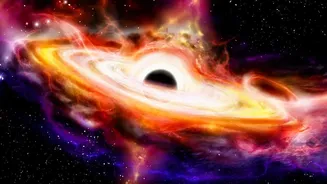
In the vastness of space, few events are as destructive as a tidal disruption event, or TDE. It is the celestial equivalent of a horror movie. When an unsuspecting star’s orbit brings it too close to a massive black hole, the black hole’s immense gravitational
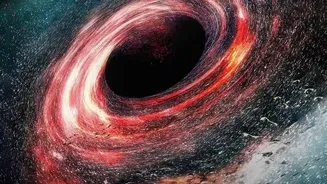
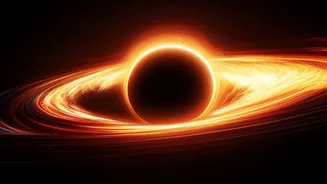
pull overwhelms the star's own gravity. The side of the star closer to the black hole is pulled much more strongly than the far side, stretching the star vertically while squashing it horizontally. This process, colorfully dubbed ‘spaghettification,’ tears the star apart. The stellar debris forms a swirling, superheated disk of material around the black hole, unleashing a brilliant flare of light that can outshine an entire galaxy for months before fading. For astronomers, these rare flares are invaluable, acting as beacons that pinpoint the location of otherwise dormant, invisible black holes.
The Usual Suspect: The Galactic Core
Until very recently, the rulebook for finding TDEs was simple: look at the center of a galaxy. Nearly every large galaxy, including our own Milky Way, is believed to host a supermassive black hole at its core, weighing millions or even billions of times the mass of our sun. These galactic monsters are the primary culprits behind TDEs. With a high concentration of stars orbiting nearby, it is statistically inevitable that once every 10,000 to 100,000 years, a star will stray into the gravitational kill zone and be torn asunder. Consequently, of the hundreds of TDEs detected over the past couple of decades, almost all have appeared exactly where expected — right in the dense, star-filled heart of a galaxy.
An Anomaly in the Outskirts
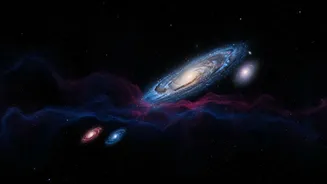
This established pattern was recently broken by an event named TDE 2025abcr. First flagged in November 2025 by the Zwicky Transient Facility in California, it initially looked like a typical TDE flare. However, its location was anything but typical. The event occurred nearly 30,000 light-years away from the center of its host galaxy, a place where a black hole massive enough to shred a star simply shouldn't be. Follow-up observations from observatories including NASA’s Neil Gehrels Swift Observatory confirmed the nature of the event, capturing its intense ultraviolet glow. The discovery was aided by a new artificial intelligence program designed specifically to hunt for these stellar death cries anywhere in the sky, not just at the galaxy's center.
The Case of the Wandering Black Hole
The discovery of TDE 2025abcr provides the strongest evidence to date for a 'wandering' massive black hole. The flare illuminated an otherwise invisible object with a mass estimated at around one million times that of our sun, adrift in the galactic suburbs. Such black holes are theoretically predicted but have been incredibly difficult to find because they produce no light on their own. A TDE is the only time they reveal themselves, lighting up like a cosmic flare on a map to say, “Here I am.” This specific event is considered the clearest direct sighting of such a displaced black hole ever seen in optical light.
Rewriting a Galaxy’s Biography
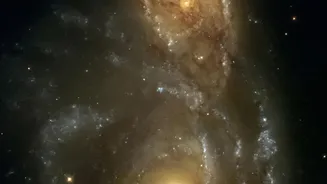
So how does a million-solar-mass black hole end up so far from home? Astronomers have two main theories. The first involves galactic mergers. When two galaxies collide and merge, their central supermassive black holes eventually spiral towards each other. In the ensuing complex gravitational dance, one of the black holes can be kicked out of the newly formed galaxy’s core and sent roaming through its halo. The second possibility is that this wandering black hole is the dense, stripped core of a smaller, dwarf galaxy that was cannibalized by the larger host galaxy long ago. The smaller galaxy was torn apart, but its central black hole survived and continues to orbit within its captor. Finding these wanderers helps us piece together the violent histories of how galaxies grow and evolve.