





An Empire of Unrivaled Opulence
The Mughal Empire, which ruled the Indian subcontinent from the 16th to the 19th century, was a realm of staggering wealth and artistic achievement. Emperors like Shah Jahan, the visionary behind the Taj Mahal, presided over a court renowned for its patronage
of exquisite craftsmanship. Jewelers in the Mughal era were masters of their trade, creating objects that were not only beautiful but also deeply symbolic. It was in this environment of peak artistry and scientific curiosity that two of the most unique optical artifacts in history were born: a pair of spectacles with emerald lenses and another with diamond lenses.
Lenses Carved From Legend
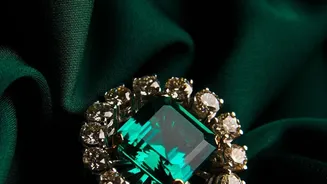
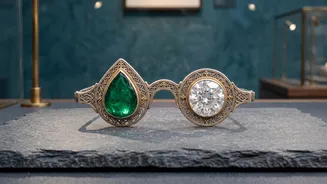
These were no ordinary glasses. One pair, poetically named 'Astaneh-ye-Ferdaws' or the 'Gate of Paradise', featured two teardrop-shaped lenses sliced from a single, colossal Colombian emerald, estimated to have originally weighed over 300 carats. The other, named 'Halqeh-ye-Nur' or the 'Halo of Light', had lenses cleaved from a Golconda diamond thought to have been over 200 carats. The sheer skill required to cut such massive, precious stones into thin, transparent lenses without shattering them represents a level of technical mastery that is almost inconceivable today. No other comparable examples are known to exist. The original 17th-century lenses were later fitted into new diamond-studded frames around 1890.
A Window to the Divine
For the Mughals, these spectacles were far more than simple vision aids. Gemstones held profound spiritual meaning. Emeralds, with their verdant hue, were deeply connected to Islamic concepts of paradise, salvation, and healing. It was believed the green lenses could ward off evil and even had miraculous healing powers. There is speculation that the emperor Shah Jahan himself may have used emeralds to soothe his eyes after weeping for his deceased wife, Mumtaz Mahal. Diamonds, on the other hand, were associated with divine light and spiritual enlightenment. To look through these lenses was to seek not just clarity of sight, but a filter for spiritual well-being.
Lost and Found Through Time
While the exact patron who commissioned these treasures is unknown, the sheer quality and size of the gems suggest they were reserved for an emperor or a high-ranking prince. After their creation in the 17th century, their history becomes murky. They likely passed through the hands of various royal figures before disappearing from public record. For centuries, they remained hidden away in a private collection. They were held within the same princely Indian family until the 1980s, when they were sold to European buyers, before resurfacing to global astonishment.
A Modern Sensation at Auction
In 2021, the 'Gate of Paradise' and 'Halo of Light' spectacles were put up for auction by Sotheby's in London, capturing the world's imagination. Offered as two separate lots, the pair of glasses carried a combined pre-sale estimate of up to $6.8 million. The auction house presented them as magnificent artifacts that brought together science, beauty, and belief. Despite the immense public interest and their undisputed rarity, both pairs failed to find a buyer at the auction. Sotheby's expressed confidence that the spectacles would eventually sell, noting the awe they inspired wherever they were exhibited. Their journey, for now, continues in private hands, a silent testament to a bygone era.