




A Ghostly Sphere of Stars
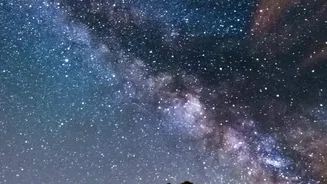
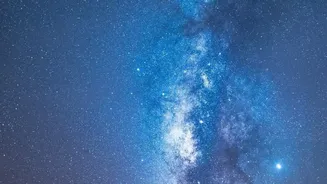
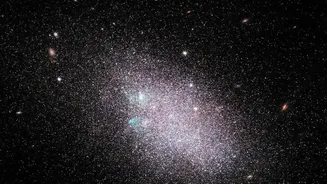
Imagine our galaxy, the Milky Way, not just as the bright, starry disk we see in the night sky, but as something much larger. Surrounding this familiar spiral is a vast, faint sphere of ancient stars known as the stellar halo. This halo is like a ghostly
attic, holding the oldest relics of our galaxy's formation. It contains only about one percent of the Milky Way's total stars, which are typically old and contain fewer heavy elements than stars like our Sun. For decades, astronomers have studied this halo to piece together our galaxy's chaotic childhood, which was dominated by the gravitational capture and destruction of smaller galaxies.
The Slow-Spinning Mystery
A long-standing puzzle has perplexed scientists: the stars in our halo are barely moving. While the stars in the main disk, including our own Sun, orbit the galactic center at a brisk 220 kilometers per second, the stars in the halo creep along at a comparatively sluggish 25 kilometers per second. This slow rotation didn't make sense if the halo was simply an assortment of stars pulled in from random directions over billions of years. Something dramatic must have happened to put the brakes on the halo and create this strange, slow-moving structure.
Uncovering a Cosmic Collision
The Durham University team believes they have found the answer in a cataclysmic event from our galaxy's distant past. About 10 billion years ago, long before our solar system formed, the Milky Way was struck head-on by a large dwarf galaxy. Astronomers have nicknamed this cosmic interloper the 'Gaia Sausage' or 'Gaia-Sausage-Enceladus,' after the European Space Agency's Gaia satellite that helped uncover its remnants. This was no mere fender-bender; it was the last major merger in the Milky Way's history and an event that fundamentally reshaped its structure.
The Great Galactic Flip
Using powerful supercomputer simulations, the Durham researchers explored how Milky Way-like galaxies evolve. Their models showed that galaxies with slow-moving halos almost always had two things in common: they had experienced a massive, head-on collision, and this collision was so powerful that it caused the entire galactic disk to flip over, changing its orientation by more than 90 degrees. The team concluded that the impact from the Gaia Sausage was so violent that it tore the smaller galaxy to shreds, scattering its stars into what is now our stellar halo. The immense gravitational chaos from this event effectively 'flipped' the entire Milky Way and slowed the halo's rotation.
Why This Discovery Matters
This discovery does more than just solve an old astronomical mystery. It provides a direct link between the motions we see in the galaxy today and a specific, violent event from 10 billion years ago. It confirms that galaxy mergers are not just about growth, but about fundamental transformation. Understanding this 'disc flip' helps astronomers build a more accurate history of our own galaxy. The fact that our Sun and solar system exist in their current stable orbit might be a direct consequence of this ancient upheaval. This research, presented at the Royal Astronomical Society's National Astronomy Meeting, gives us a valuable window into how galaxies like our own are built over cosmic time. It's a reminder that even in the vastness of space, the past is never truly gone; it's simply waiting to be read in the motion of the stars.