
A Cosmic Ménage à Trois
Finding a supermassive black hole is no longer a surprise; we know they lurk at the heart of most large galaxies, including our own Milky Way. Finding two is a treat, usually indicating that two galaxies are in the slow-motion process of merging. But
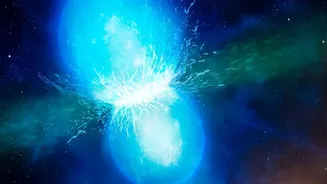
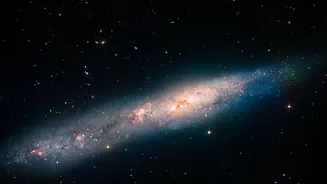
finding a trio of them actively feeding within the same galaxy is an exceptionally rare event. An international team of astronomers, using the powerful James Webb Space Telescope (JWST), has identified just such a system in a distant galaxy known as J0148-4214. This isn't just a curiosity; it's a living laboratory for understanding one of the biggest puzzles in cosmology: how supermassive black holes got so enormous, so quickly, in the early days of the universe.
Seeing the Unseeable
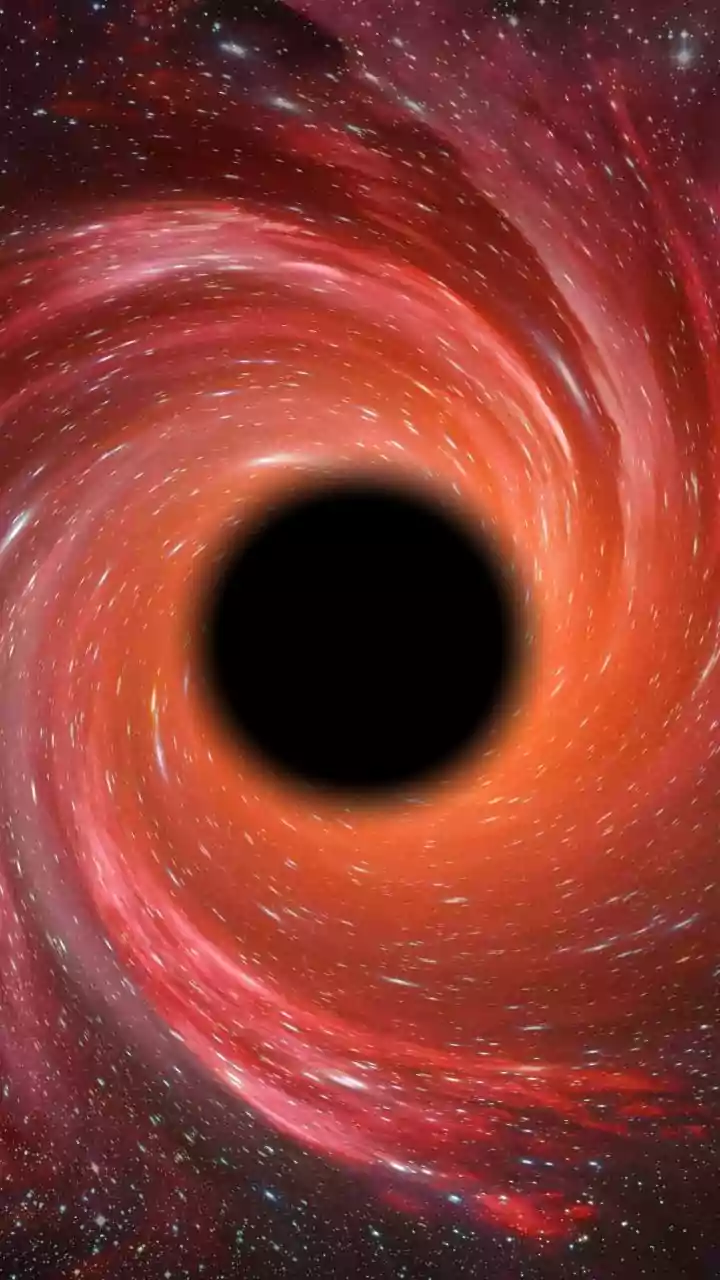
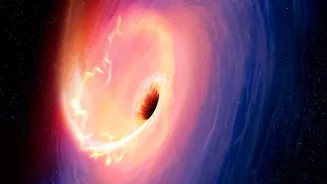
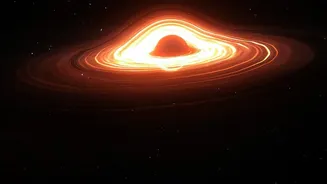
Black holes, by their very nature, are invisible. So how did astronomers spot this trio? They didn't see the black holes themselves, but rather the brilliant turmoil around them. Using a specialized instrument on the JWST called the Near-Infrared Spectrograph, a team led by Hannah Übler of the Max Planck Institute for Extraterrestrial Physics was able to detect the tell-tale signs of gas swirling at incredible speeds. This gas forms a blazing hot accretion disk as it's pulled toward a black hole's point of no return. The unique light signatures allowed the team to distinguish three separate, actively feeding black holes. Two are locked in a close embrace near the galaxy's center, separated by a mere 620 light-years, while a third lies further out, about 5,500 light-years away.
The Fast Track to Growth
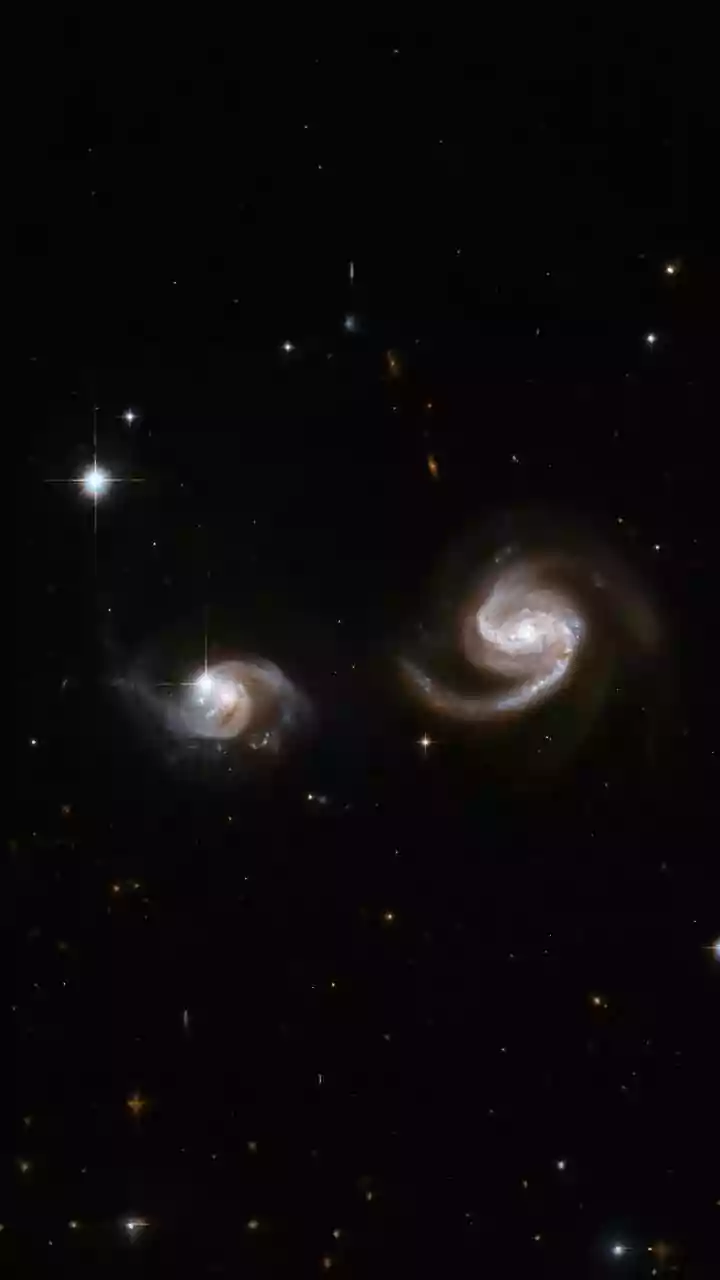
This discovery provides powerful support for a theory known as 'merger-led growth.' For years, scientists have debated how the universe's first supermassive black holes grew to billions of times the mass of our sun in less than a billion years after the Big Bang. One model suggests they grew slowly, sipping a steady diet of interstellar gas. Another, more chaotic model posits they grew in rapid bursts by merging with other black holes during violent galaxy collisions. The system in J0148-4214 is a poster child for the latter. We are witnessing three galaxies, each with its own central black hole, in the process of becoming one. This pile-up provides a much faster and more efficient way to build a colossal black hole than the slow-and-steady approach.
A Glimpse into the Past and Future
Because J0148-4214 is 12.5 billion light-years away, we are seeing it as it existed when the universe was just a toddler, only about 1.2 billion years old. This makes the discovery a precious time capsule. It confirms that the conditions for these multi-galaxy mergers were in place very early in cosmic history. The two central black holes, with estimated masses of 80 million and 0.6 million times that of our sun, are on a collision course and are expected to merge in a few hundred million years. The third, with a mass of about 2 million suns, may be a remnant from a previous merger or is slowly making its way toward the center. These future collisions will unleash stupendous amounts of energy in the form of gravitational waves, the very ripples in spacetime that future observatories hope to detect.